Do Pheromones in Perfume Actually Work? A Natural Perfumer’s View
By Kershen Teo | Founder & Perfumer, Prosody London
At a Glance — Do Pheromone Perfumes Actually Work?
This guide examines whether pheromone perfumes work — assessing the clinical evidence on androstenone and androstenol, the synthetic compounds used in most pheromone fragrances — and presents botanical alternatives from Prosody London: Jacinth Jonquil, Carissis, Rose Rondeaux, and Santal Foy. “Organic perfumes are very hard to make — these guys are very good at it.” — Luca Turin, perfume critic.
For occasion-specific picks, see the best women’s perfumes for dating 2026 and the best men’s fragrance for dating 2026.
Pheromones in perfume are one of the beauty industry’s most persistent myths. Every few years the category goes viral — TikTok discovers it, beauty editors round up the best ones, and the marketing machine promises that a single spray will make you irresistible.
Here’s what those articles don’t tell you: the dedicated pheromone detection organ in humans is vestigial. The genes that make it functional in mice are largely switched off in our species. The classical pheromone pathway that perfume marketing implies simply doesn’t operate in adult humans the way the industry suggests.
What follows is my assessment of what current evidence suggests, what many products contain, and what botanical perfumery can realistically offer instead.
Are Pheromone Perfumes Safe? The Ingredients Question
This is the question the marketing never answers — and the reason it matters more than whether they work.
Most commercial pheromone perfumes contain two categories of ingredient that warrant scrutiny: the pheromone compounds themselves, and the synthetic musks used to deliver the skin-close, intimate quality the category promises.
Androstenone and androstenol — the pheromone compounds
Androstenone and androstenol are synthetic steroid compounds derived from human axillary secretions. The evidence for long-term cosmetic use of these compounds is limited, and regulatory oversight of pheromone-specific compounds differs from that applied to conventional fragrance ingredients under REACH. There is no required safety dossier specific to these compounds in cosmetic use, and long-term human dermal exposure data remains limited.
At higher concentrations, androstenone is perceived by roughly a third of people as deeply unpleasant — described in studies as urine-like or aggressively sweaty — while another third cannot smell it at all (Keller et al., 2007, Nature, DOI: 10.1038/nature06162). Androstenol at lower concentrations may produce mild mood effects in some subjects, but the data is inconsistent and the safety profile at repeated dermal exposure levels is unknown.
Synthetic musks — the bigger concern
The more significant safety issue is not the pheromone compounds but what surrounds them. Most pheromone fragrances achieve their skin-close, long-lasting quality through polycyclic synthetic musks — primarily Galaxolide and Tonalide. A 2005 study published in Chemosphere (PMID 15537743) detected both compounds in human blood and breast milk, confirming bioaccumulation in human tissue.
A subsequent review in Environmental Science and Technology confirmed their persistence in aquatic environments and documented reproductive disruption in fish at environmentally relevant concentrations. Musk Xylene — present in some older formulations — has been designated a substance of very high concern by the European Chemicals Agency under REACH, classified as very persistent and very bioaccumulative (ECHA SVHC dossier, 2008).
Another consideration is the environmental and toxicological literature surrounding some of these synthetic musk ingredients. You are applying compounds that bioaccumulate in tissue — to your skin, in the name of attraction — while some synthetic musks have been studied for environmental persistence and potential endocrine-related effects in research settings. Their relevance to human health at cosmetic exposure levels remains an area of ongoing scientific investigation.
The botanical alternative
Ambrette seed, labdanum, genuine sandalwood, and jasmine absolute achieve the same skin-close, evolving, intimate quality through entirely different chemistry. Botanical materials such as ambrette seed, labdanum, genuine sandalwood and jasmine absolute are used for their olfactory properties and skin-chemistry interaction rather than for any claimed hormonal effect. They are not associated with the bioaccumulation concerns documented for polycyclic synthetic musks, and have been more extensively studied in relation to mood and emotional response through the olfactory pathway — which we cover in detail in our guides to endocrine disruptors in perfume and hidden chemicals in perfume.
What are pheromones — and do humans even have them?
Pheromones are chemical signals secreted by one individual that trigger a specific, predictable behavioural or physiological response in another member of the same species. In insects the science is unambiguous — ants use pheromones for trail marking, moths for mating signals, honeybees for alarm responses. The mechanism is direct, consistent, and measurable.
In mammals the picture is more complex. Most mammals detect pheromones through the vomeronasal organ (VNO) — a dedicated chemosensory structure in the nasal cavity that sends signals directly to the hypothalamus, bypassing conscious thought entirely. In rodents this system is well-documented and drives reproductive and territorial behaviour.
The problem for pheromone perfume marketing is this: in humans, the VNO is vestigial. The genes encoding VNO receptors — the V1R and V2R gene families — are largely pseudogenes in humans, meaning they exist in the genome but don’t produce functional proteins. A 2000 study in Nature Neuroscience by Keverne confirmed that the human VNO lacks the neural connections to the hypothalamus that make it functional in other mammals. The dedicated pheromone detection pathway that perfume marketing implies simply doesn’t operate in adult humans the way it does in mice.
This doesn’t mean human chemosensory communication doesn’t exist. It means it doesn’t work through the classical pheromone pathway — and that’s a crucial distinction the industry rarely makes.
What pheromone perfumes actually contain
The compounds most commonly used in commercial pheromone fragrances are synthetic versions of androstenone and androstenol — steroid compounds found in human sweat, particularly in axillary secretions. The marketing proposition is straightforward: add synthesised versions of these compounds to a fragrance, apply to skin, trigger attraction in others.
The clinical evidence doesn’t support this. A comprehensive 2015 meta-analysis in the journal Proceedings of the Royal Society B examined putative human pheromones and found no robust evidence that androstenone or androstenol produced reliable, predictable behavioural effects — with positive results likely to be false positives due to small sample sizes and publication bias.
What many products marketed as pheromone perfumes actually contain is simply a well-formulated skin-scent fragrance with musks and warm woods. The pheromone claim is marketing language for “this smells intimate and skin-like.” Which is a real effect — just not a pheromonal one.
What actually does work — aromatic analogues and the limbic pathway
This is where the science becomes genuinely interesting, and where botanical perfumery has something real to offer.
Human attraction and arousal through scent operate through the olfactory system, not the VNO. Aromatic compounds inhaled through the nose reach the olfactory bulb within milliseconds — the only sensory pathway with a direct connection to the limbic system, the brain’s emotional and memory centre, bypassing rational thought entirely. This pathway is real, well-documented, and significantly more powerful than most people understand.
Certain botanical materials interact with this pathway in ways that produce measurable emotional and physiological responses. These are not pheromones in the biological sense. They are what I’d call aromatic analogues — compounds that engage the olfactory system through different mechanisms and have been studied for their effects on mood and emotional processing.
For a detailed examination of how this olfactory-limbic pathway also affects stress, anxiety and mood through specific botanical compounds, read our guide to calming perfume and the botanical science behind it.

The key botanical materials studied in relation to mood, emotional responses and aspects of physiological arousal:
Indole — present in jasmine absolute (Jasminum grandiflorum and sambac). Indole is structurally similar to certain human chemosensory compounds and has a warm, animalic, almost skin-like quality at low concentrations. Some controlled studies have reported increases in salivary testosterone following jasmine inhalation — including a 2019 study, “Exposure to Essential Oil Odors Increases Salivary Testosterone Concentration in Perimenopausal Women” — although findings remain limited, the study involved 15 perimenopausal women per oil, and results should not be interpreted as evidence that wearing perfume produces the same effects. This is not a pheromone effect — it’s a direct olfactory-limbic response to a botanical compound.
Macrocyclic musks — ambrette seed (Abelmoschus moschatus). Unlike synthetic musks (galaxolide, tonalide), ambrette seed produces a genuinely skin-like, warm musk quality through macrocyclic lactone compounds. Their odour profile activates olfactory pathways responsible for perceiving musky scents, in ways that synthetic musks approximate but don’t fully replicate. Ambrette seed has been used in Ayurvedic medicine as a sensual tonic for centuries — and the molecular basis for that use is increasingly understood.
Labdanum (Cistus ladaniferus) — one of perfumery’s oldest materials, used across Greek, Roman, and Vedic traditions for intimacy and ritual. Its warm, resinous, amber-leathery character carries a subtle animalic warmth that evolves with body heat. Labdanum’s primary aromatic compounds have been associated with warm, comforting emotional responses in fragrance perception studies.
Civetone and muscone analogues in natural materials — before synthetic musks replaced them, civet and natural musk were used in perfumery precisely because of their skin-affinity and their perceived effect on attraction. The ethical concerns around animal-derived musks led to their replacement with synthetics — but the botanical alternatives (ambrette, angelica root, certain labdanum fractions) preserve the olfactory effect without the ethical and health concerns.
The Vedic understanding — gandha as chemosensory communication
Ancient Indian perfumery tradition offers a framework for understanding scent’s role in attraction that predates modern neuroscience by millennia — and converges with it in striking ways.
In Sanskrit, gandha means scent — but in Ayurvedic philosophy it carries a broader meaning: the direct communication between bodies through aromatic signals, bypassing language and conscious thought. Vedic physicians classified aromatic plants not as decorative ingredients but as medicines — prescribed for intimacy, emotional opening, and the restoration of ojas, the vital essence governing sexual energy and radiance.

The materials they selected — jasmine, rose, sandalwood, labdanum equivalents, musk-bearing plants — were chosen independently across multiple ancient traditions for the same purposes.This convergent selection across cultures that had no contact with each other is an interesting historical phenomenon that modern researchers continue to explore. Some modern research has begun to investigate biological mechanisms that may help explain why certain aromatic materials have remained culturally significant across traditions, although these studies do not validate traditional spiritual interpretations.
Gandha was understood as a third scent — the accord between the fragrance and the individual’s own chemistry. This is precisely what botanical perfumers mean when we talk about how natural materials evolve on skin. A synthetic musk like galaxolide projects consistently and identically on everyone. Ambrette seed and labdanum evolve with the wearer — creating a personalised accord that is different on every skin. That evolution is not a weakness of natural perfumery. In my view, this creates a more individual wearing experience than highly uniform synthetic compositions.
What Botanical Perfumes May Offer Instead
Synthetic pheromone products make a specific and largely unsupported claim: that adding synthesised androstenone or androstenol to a fragrance will trigger attraction in others. The evidence doesn’t support this.
Botanical ingredients used in perfumery have been studied for several effects that are distinct from pheromone claims:
Certain botanical materials have been studied for their relationship with cortisol levels and physiological stress responses in specific research settings. Clary sage inhalation has been associated with cortisol reductions of up to 36% in some studies. Ylang ylang has been studied for its relationship with autonomic nervous system activity. Rose absolute has been examined for cortisol-related effects and emotional wellbeing in aromatherapy research — though findings vary and these are not claims about what wearing a finished perfume does.
They interact with the limbic system directly — producing measurable effects on mood, arousal markers, and emotional state through the olfactory pathway.
They evolve on skin — creating the “third scent” that synthetic fixatives cannot produce. The accord between a botanical fragrance and individual skin chemistry is genuinely unique to each wearer, which is the closest thing to a personal olfactive signature that perfumery can produce.
Synthetic musks achieve their projection through metabolic inertness — they don’t react with skin chemistry because they’re designed not to. That’s why they project consistently. It’s also why they don’t create the intimate, evolving skin-scent that makes a fragrance feel like it belongs to you.
For a full breakdown of these ingredients and the clinical evidence, see our guides to endocrine disruptors in perfume and hidden chemicals in perfume.
Which Prosody London perfumes work as natural pheromone perfume?
If what you’re looking for is a fragrance that genuinely interacts with your skin chemistry, evolves across hours, and contains the botanical compounds with the strongest documented effects on mood and attraction — these are the relevant fragrances from the Prosody London collection:

Jacinth Jonquil→
Made of jasmine grandiflorum oil, ylang ylang, cardamom, labdanum. The most densely aromatic of the collection in terms of compounds with documented limbic effects. The indolic character of the jasmine absolute is the key material.

Carissis→
Made of ambrette seed as the central musk material. The cleanest natural musk alternative available, with genuine skin-affinity and the macrocyclic lactone structure that makes it evolve intimately on skin.

Santal Foy→
Composed with genuine Mysore sandalwood from sustainable East Timor cultivation. Sandalwood’s α-santalol has been studied for its relationship with relaxation and parasympathetic nervous system activity through inhalation — the Ayurvedic ojas-building material par excellence.

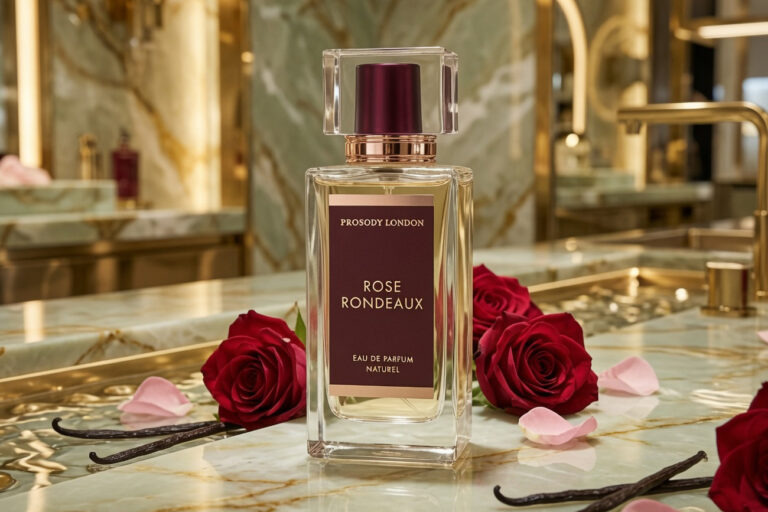
Rose Rondeaux→
Uses Rosa damascena oil, labdanum, frankincense. Rose absolute has been studied in clinical aromatherapy research for its relationship with cortisol levels and emotional wellbeing. For the full assessment of Rose Rondeaux against mainstream rose fragrances, see our guide to the best rose perfume.
For a broader edit of the best women’s perfumes with documented botanical ingredients, see A Working Perfumer’s Edit: 24 Best Women’s Perfumes 2026.
→ Try all four in our natural perfume sample set
The hidden ingredient problem — what pheromone perfumes are actually made of
This is the section that fragrance marketing never includes — and the reason a working perfumer needs to say it plainly.
The vast majority of commercial pheromone perfumes achieve their skin-close, intimate, evolving quality not through pheromone compounds but through synthetic musks. Galaxolide, Tonalide, Habanolide, Iso E Super — these are the materials doing the actual work in most products marketed as pheromone fragrances. They project consistently, they last, and they create the impression of skin-warmth that makes a fragrance feel intimate.
Another consideration is the environmental and toxicological literature surrounding some of these synthetic musk ingredients.
Galaxolide and Tonalide have been widely studied because of their persistence in the environment and their tendency to bioaccumulate. Both have been detected in environmental samples and human tissues, prompting ongoing regulatory and scientific attention.
A 2025 review in the Journal of Chemical Health Risks found both compounds detected in wastewater and surface water globally, with low-level exposure shown to alter reproductive behaviour in aquatic animals. More critically for the wearer: both bioaccumulate in human adipose tissue, blood, and breast milk. Their widespread environmental presence, bioaccumulation and potential endocrine activity remain subjects of ongoing toxicological research, although the implications for cosmetic exposure in humans remain uncertain.
Musk Xylene — still present in some older formulations — has been designated a substance of very high concern by the European Chemicals Agency under REACH regulation, classified as very persistent and very bioaccumulative. It has been detected in human breast milk in multiple independent studies.
Iso E Super (OTNE) — widely used in niche and mainstream perfumery to create the woody skin-scent effect associated with “pheromone” fragrances — is a listed skin sensitiser under EU CLP classification (H317). The European Scientific Committee on Consumer Safety has recommended it for updated allergen labelling.
You are applying compounds that bioaccumulate in tissue — to your skin, in the name of attraction — while some synthetic musks have been studied for potential endocrine-related effects in research settings. Their relevance to human health at cosmetic exposure levels remains an area of ongoing scientific investigation.
A 2022 systematic review in the Journal of Environmental Health Science and Engineering found widespread detection of phthalates and other pollutants across commercial perfumes tested, with diethyl phthalate — used as a fixative to extend longevity — among the most consistently detected compounds.
For a full breakdown of these ingredients and the clinical evidence, see our guides to endocrine disruptors in perfume and hidden chemicals in perfume.
Botanical materials such as ambrette seed, labdanum, genuine sandalwood and jasmine absolute are used for their olfactory properties rather than for any claimed hormonal effect, and are not associated with the bioaccumulation concerns documented for polycyclic synthetic musks.
FAQ — pheromones in perfume
Do pheromones in perfume work?
Not in the way the marketing implies. The clinical evidence for synthetic androstenone and androstenol producing consistent, reliable attraction responses in humans is weak. What well-formulated “pheromone” fragrances often do is smell intimate, skin-close, and evolving — which is a real effect produced by musk materials, not by pheromone compounds.
Do humans have pheromones?
Humans produce chemical compounds in sweat and skin secretions that may influence social behaviour — but the dedicated pheromone detection organ (VNO) is vestigial in adult humans, and the classical mammalian pheromone pathway does not appear to operate in the way it does in rodents. Human chemosensory communication is real but operates through the olfactory system rather than a dedicated pheromone pathway.
Are pheromone perfumes safe?
The pheromone compounds themselves (androstenone, androstenol) have limited long-term dermal safety data in cosmetic use. The synthetic musks used alongside them — including Galaxolide, Tonalide and, in some older products, Musk Xylene — have been studied because of their persistence, bioaccumulation and environmental effects. Published long-term data on repeated dermal exposure in cosmetic use remain limited.
What is the difference between a pheromone perfume and a natural botanical perfume?
A pheromone perfume typically contains synthetic steroid compounds (androstenone, androstenol) claimed to trigger attraction. A natural botanical perfume contains plant-derived aromatic compounds studied in relation to mood, emotional responses and aspects of physiological arousal — operating through the olfactory pathway rather than a pheromone mechanism. Botanical fragrance materials have been studied more extensively in relation to mood, stress and emotional response through the olfactory pathway than synthetic pheromone compounds marketed for attraction.
What natural ingredients have the strongest effects on attraction and mood?
Jasmine absolute (indole content, research exploring effects on testosterone and physiological arousal), ambrette seed (macrocyclic musk, skin-affinity), labdanum (animalic warmth, skin evolution), ylang ylang (associated with parasympathetic nervous system activity in some studies), and rose absolute (studied in relation to cortisol levels and emotional wellbeing). All are present across the Prosody London range.
Is ambrette seed a natural pheromone?
No — ambrette seed is a macrocyclic musk derived from Abelmoschus moschatus seeds. It is not a pheromone. It does produce a genuine skin-like, musky warmth through its lactone compounds that interacts with the olfactory system in ways that feel intimate and evolving on skin. It is often regarded by natural perfumers as one of the closest botanical approximations to a skin-like musk accord.