Endocrine Disruptors in Perfume: The Perfumer’s Honest View
By Kershen Teo, founder and natural perfumer of Prosody London
At a Glance: Endocrine disruptors to avoid in perfume
A number of fragrance ingredients have attracted scientific and regulatory attention because of their potential biological activity. These include certain phthalates, parabens, and synthetic musks such as galaxolide and tonalide. Research has investigated their persistence, endocrine activity, and potential effects under particular exposure conditions, although evidence from laboratory or observational studies does not automatically establish harm from normal perfume use. Botanical perfumes formulated without synthetic aroma chemicals, preservatives, or synthetic musks take a different approach to ingredient selection.
I have been formulating exclusively with botanical ingredients for over a decade. That experience has made me particularly interested in understanding exactly what goes into a fragrance — not only how beautiful a material smells, but how its origin, concentration, formulation, and intended use affect the finished product.
This article looks at the ingredients that have attracted the most discussion, what the scientific evidence actually tells us, and where the evidence remains uncertain. It also explains why formulation choices and ingredient transparency matter when deciding what kind of fragrance is right for you.
What Are Endocrine Disruptors?
Endocrine disruptors are chemicals that can interfere with the body’s hormonal system — for example, by mimicking, blocking, or altering hormone signalling. Because perfume is applied directly to the skin and may be used repeatedly, researchers have investigated whether exposure to certain fragrance and cosmetic ingredients could contribute to endocrine-related effects.
A 2025 narrative review published in Frontiers in Toxicology examined potential health effects associated with perfumes and cosmetics, including endocrine disruption and reproductive health. The review highlighted ingredients such as certain phthalates and parabens as areas of scientific interest, while also noting the need for further research into exposure, risk, and long-term effects.
Importantly, evidence that an ingredient can show endocrine activity in laboratory or observational research does not by itself establish that normal perfume use causes harm in humans. Risk depends on the specific substance, concentration, route and duration of exposure, and the available human evidence.
For fragrance, the ingredients most often discussed in this context include certain phthalates, parabens, and synthetic musks. The evidence is not identical for each substance, so it is worth looking at them individually rather than treating the entire category of fragrance ingredients as a single health risk.

Phthalates in Perfume: What They Are and Why They Are Used
Phthalates are a group of synthetic chemicals used in a wide range of products, and some have been used in fragrance formulations as solvents or fixatives. Diethyl phthalate (DEP) is the phthalate most commonly discussed in connection with personal fragrance products.
A systematic review published in PMC examining pollutants in perfumes and colognes found phthalates among the chemicals detected in these products. The review discusses research linking certain phthalates with reproductive, hormonal and neurological effects, although the presence of a chemical in a fragrance product does not by itself establish a health risk from normal use.
A separate PubMed study that screened 47 branded perfumes reported DEHP in 7 of 28 European-manufactured products at concentrations the authors considered above applicable legal limits. DEHP is subject to restrictions in EU cosmetics, making the finding relevant to questions around formulation and regulatory compliance. The study’s results are worth understanding, but they should be considered in the context of the specific products, concentrations and regulations examined.
A 2024 review published in MDPI Endocrines discusses several phthalates, including dibutyl, dipentyl, benzyl butyl and diphenyl phthalates, in the context of endocrine activity. The mechanisms discussed include effects on hormone signalling and reproductive pathways. Importantly, evidence of endocrine activity for a particular substance does not automatically mean that exposure through perfume produces the same effect in humans.
As a perfumer, I choose not to use phthalates. My approach is primarily formulation-driven: botanical fragrances built around concentrated organic alcohol and natural aromatic materials such as benzoin, labdanum and agarwood can achieve longevity and character without relying on added phthalates. That is a different formulation philosophy rather than a claim that every synthetic material is inherently unsafe.
For a more practical guide to checking whether a fragrance contains phthalates and what to look for in an ingredients list, see our phthalate-free perfume guide.
Parabens in Perfume: The Preservation Problem
Parabens — including methylparaben, ethylparaben, propylparaben and butylparaben — are preservatives used to help prevent the growth of bacteria and fungi. They are more relevant to water-containing cosmetic formulations, where microbial control can present a genuine formulation challenge, although many different preservation systems are available.
Parabens have attracted scientific attention because some members of the group can interact with oestrogen receptors and have shown endocrine activity in laboratory studies. They have also been detected in human tissues and biological samples. Research published in the Journal of Applied Toxicology by Darbre et al. (2004) reported parabens in human breast tumour tissue, which contributed to wider scientific and public interest in potential exposure to parabens. The finding, however, did not establish that parabens caused the tumours or demonstrate a causal link between cosmetic use and breast cancer.
The important formulation point — one I explain in more detail in our paraben-free perfume guide — is that preservation requirements depend on the formulation. Water-containing products generally require an appropriate preservation strategy, while sufficiently concentrated alcohol-based perfumes can have strong antimicrobial properties and may not require conventional preservatives. Parabens are therefore a formulation choice rather than an inevitable ingredient in perfume.
As a perfumer, I choose to formulate without parabens. For me, the more useful question is not simply whether a fragrance carries a “paraben-free” claim, but what the formula actually contains and why those ingredients are needed.
The “Parfum” Problem: What the Label Doesn’t Tell You
The word “parfum” or “fragrance” on an ingredients list is a collective declaration that can represent multiple individual fragrance ingredients rather than listing every aromatic component separately. In the UK and EU, fragrance compositions can receive this type of collective declaration, while certain individual fragrance allergens may still need to be identified when they meet the applicable labelling thresholds.
That means an ingredient list may not tell you the complete chemical composition of a fragrance. A PMC study on endocrine disruptors and consumer products found that a number of chemicals detected in fragranced consumer products were not individually identified on product labels, and discussed the presence of phthalates and the use of less-studied substitutes in some products.
This does not mean that every fragrance labelled “parfum” contains phthalates, synthetic musks, or other ingredients of concern. Nor does a collective fragrance declaration by itself indicate that a product is unsafe. It does, however, illustrate why transparency can be useful for consumers who want to understand more about a formulation than the standard ingredient declaration provides.
For me, a meaningful “phthalate-free” claim is one that reflects the actual formulation and can be supported by the brand’s ingredient policy or formulation information, rather than relying on the phrase as a standalone marketing message.

Synthetic Musks: The Less-Discussed Disruptors
Phthalates and parabens receive considerable attention, but synthetic musks have also attracted scientific interest because of their persistence, environmental behaviour, and potential biological activity.
Polycyclic musks — including galaxolide (HHCB) and tonalide (AHTN) — have been widely used in fragrance formulations for their soft, clean, skin-close character and lasting presence. Research has investigated their environmental persistence and potential endocrine activity, and these compounds have been detected in environmental samples as well as human biological samples, including breast milk. These findings demonstrate exposure and biological activity, but they do not by themselves establish that normal perfume use causes endocrine disruption in humans.
The 2024 review published in MDPI Endocrines discusses galaxolide and related synthetic musks in the context of endocrine activity, including research into interactions with nuclear receptors and steroid signalling pathways. As with other fragrance ingredients, the significance of these findings depends on the substance, concentration, route and duration of exposure.
I do not use synthetic musks in any Prosody London fragrance. The musk character in our formulas comes instead from botanical materials such as ambrette seed, which has a naturally soft, skin-close character. I choose this approach because it fits the formulation philosophy of the house: working with botanical materials and allowing their own complexity to provide character and persistence rather than recreating every effect through synthetic aroma chemicals.
What the Science Says: Reading the Evidence Honestly
I want to be precise about what the peer-reviewed evidence does and does not show, because overclaiming in either direction serves nobody.
Research has found that certain phthalates, parabens and synthetic musks can show endocrine activity in laboratory and animal studies, including effects on hormone receptors and signalling pathways. What is less certain is how these findings translate to typical human exposure from perfume specifically, including the dose-response relationship and the long-term health significance of repeated, low-level exposure.
Regulatory authorities assess cosmetic and fragrance ingredients using available toxicological evidence, exposure estimates and established safety frameworks. These assessments are based on intended uses and expected levels of exposure. At the same time, scientific research continues to examine questions around cumulative exposure from multiple products and whether particular groups or exposure scenarios warrant additional consideration.
For consumers who prefer a precautionary approach, choosing fragrances formulated without particular ingredients can be a reasonable personal preference. That is the approach I have taken with Prosody London: I choose to formulate without synthetic musks, added phthalates or parabens because it aligns with the botanical formulation standard I have set for the brand. That is a formulation choice, not a claim that every synthetic ingredient is harmful or that botanical fragrance is universally safer.
How to Find Out More About Your Perfume’s Ingredients
Check the ingredient list for individually named phthalates, where these are disclosed. Keep in mind that fragrance compositions can be declared collectively as “parfum” or “fragrance,” so the standard ingredient list may not reveal every individual aromatic material.
If the formula contains water or “aqua,” look for the preservation system as well. Water-containing products generally require appropriate measures to control microbial growth, but that does not mean they necessarily contain parabens. If this is important to you, ask the brand which preservatives or preservation system it uses.
You can also ask the brand directly whether the fragrance contains synthetic musks such as galaxolide (HHCB) or tonalide (AHTN), particularly if you are choosing to avoid these ingredients.
Finally, ask how the fragrance achieves its longevity and stability. A transparent brand should be able to explain its general formulation approach and identify any particular ingredient categories it chooses to avoid. That information can be more useful than relying on broad terms such as “clean” or “non-toxic” alone.

Why Botanical Perfumery Can Take a Different Formulation Approach
Every Prosody London fragrance is formulated with certified organic grain alcohol and 100% botanical aromatic ingredients. Our formulas contain no added water, synthetic preservatives, phthalates, parabens or synthetic musks.
This is a consequence of the formulation approach we have chosen rather than a broad claim about botanical perfumery as a category. Our high-concentration alcohol-based formulas provide an environment that does not require the conventional preservation systems used in many water-containing products. Natural aromatic materials such as agarwood, benzoin and labdanum also contribute richness, persistence and depth, while botanical materials such as ambrette seed can provide a naturally soft, musky character.
The result is a fragrance style designed to achieve character and longevity without the synthetic ingredients discussed in this article. To explore the formulation philosophy in more detail, see our organic perfume guide.

Discover Endocrine-Disruptor-Free Perfume
Our fragrances free from phthalates, parabens and synthetic musks:
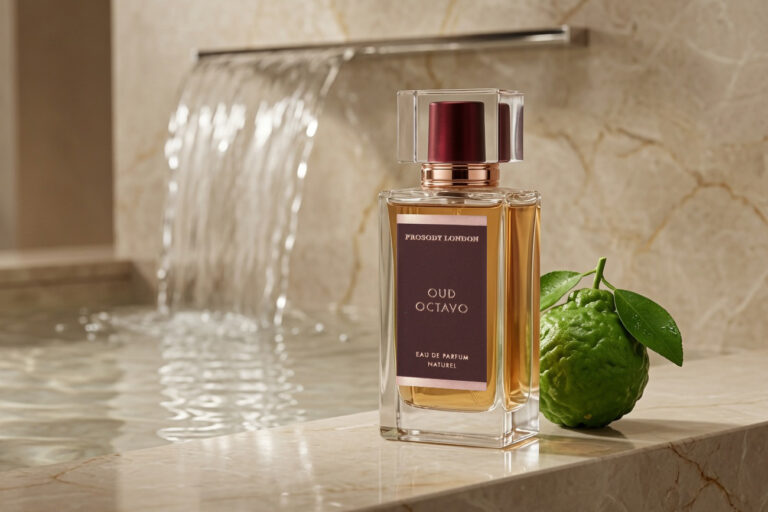
Oud Octavo — Deep resinous oud with cedarwood and smoky amber. Rich, long-lasting, entirely botanical.
Rose Rondeaux — Full-bodied organic rose with soft botanical musks and a warm patchouli dry-down.
Jacinth Jonquil — Luminous floral built around jonquil absolute with green and powdery depth.
Ocean Commotion — Fresh aquatic cologne with citrus and sea salt, clean and skin-close.
A Capella Ray — Bright citrus unisex cologne with lemongrass, jasmine and clary sage.
Bebop Allure — Fruity floral with Cox apple, Bulgarian rose, and a botanical vetiver base.
Not sure where to start? Our natural perfume sample set lets you try any six fragrances as 2ml samples — enough to wear each one through a full day. You can also read about our clean perfume worth knowing guide to know what perfumes are on that list.

FAQ
What are endocrine disruptors in perfume?
Endocrine disruptors are chemicals that can interfere with the body’s hormonal system. In fragrance discussions, ingredients that have attracted scientific attention include certain phthalates, parabens and synthetic musks such as galaxolide and tonalide. Research has investigated their endocrine activity, persistence and potential effects under different exposure conditions. The evidence is not identical for every substance, so each ingredient needs to be considered individually
Are endocrine disruptors in perfume dangerous?
The answer depends on the specific substance, concentration, route and duration of exposure. Some phthalates, parabens and synthetic musks have shown endocrine activity in laboratory or animal research, but these findings do not automatically establish harm from normal perfume use in humans. Regulatory authorities assess cosmetic ingredients using available toxicological evidence and expected exposure, while research into cumulative exposure and long-term effects continues. Consumers who prefer a precautionary approach can choose formulations that disclose and avoid particular ingredient categories.
How do I know if my perfume contains endocrine disruptors?
Start with the ingredient list and look for individually named ingredients where they are disclosed. Fragrance compositions can be declared collectively as “parfum” or “fragrance,” so the standard ingredient list may not reveal every individual aromatic material. If you want to avoid particular ingredients, ask the brand directly whether the formula contains phthalates, parabens or synthetic musks such as galaxolide (HHCB) or tonalide (AHTN).
Does natural perfume contain endocrine disruptors?
Natural materials are not automatically free from biological activity. Botanical ingredients can contain naturally occurring compounds that interact with the skin or other biological systems, and some can also cause irritation or sensitisation. A genuinely botanical fragrance can, however, be formulated without synthetic musks, added phthalates or parabens. See our natural perfume vs synthetic perfume guide for a fuller comparison of the two approaches.
What is the “parfum” loophole?
“Parfum” or “fragrance” is a collective ingredient declaration that can represent multiple fragrance ingredients rather than naming every aromatic component individually. Certain fragrance allergens may still need to be declared separately when applicable labelling thresholds are met. This means the standard ingredient list may not provide a complete picture of a fragrance composition, which is why consumers with specific ingredient preferences may find it useful to ask the brand for additional formulation information.
Are Prosody London fragrances free from endocrine disruptors?
Yes. Prosody London fragrances are formulated with certified organic grain alcohol and 100% botanical aromatic ingredients, without added water, synthetic preservatives, phthalates, parabens or synthetic musks. This is the formulation standard we have chosen for the brand. It allows us to create our fragrances using botanical materials rather than the synthetic ingredient categories discussed throughout this article. As with any cosmetic product, individual ingredient information and formulation details should be checked with the brand if you have a specific allergy, sensitivity or ingredient requirement.