


Powdery Perfume Is Back — And Natural Does It Best
By Kershen Teo, Founder and Perfumer, Prosody London
Most powdery perfumes last because of synthetic musks — compounds that carry real questions about hormonal health and environmental persistence. At Prosody London I take a different route: eight botanical fragrances whose powdery drydown is achieved through rice bran vanillin and clary sage-derived ambroxan, not petrochemicals. The result is a powdery perfume that lasts, feels genuinely skin-close, and is made entirely from natural ingredients. This article explains how — and why the botanical approach does it better than synthetic.
But before I explain how we do it, it is worth understanding where the powdery fragrance tradition came from, why it fell out of favour, and why it is unmistakably back.
A History Written in Rice and Iris
The powdery accord did not begin in a laboratory. It began in Renaissance Europe, where orris root — the dried rhizome of the iris flower — was ground into face powders used by aristocrats. Iris pallida from the fields around Florence became so prized the city adopted it as its symbol. The rhizomes required three to five years of ageing before yielding their characteristic scent, making orris one of the most expensive natural materials in perfumery, then as now.
The modern powdery family was born in the Belle Époque, when synthetic molecules allowed perfumers to replicate the effect at scale. Ionones captured the violet-iris quality; heliotropine added almond warmth; vanillin brought roundness to the base. Then in 1921 Ernest Beaux created Chanel No. 5 — wrapping jasmine and rose in aldehydes that gave the composition its crystalline, powdery radiance. Powdery became synonymous with luxury, femininity, and Parisian elegance. As The Perfume Society notes, orris has been at the heart of powdery fragrance for centuries — and remains one of the most prized ingredients in perfumery today.
By the early 2000s that association had curdled. It was your grandmother’s scent. The industry pivoted to aquatic and fresh directions — and powdery quietly waited.
Why Powdery Is Back
The clean beauty movement played an unexpected role. As consumers began scrutinising synthetic ingredients, the skin-close intimacy of powdery fragrance began to read differently — not fusty, but human. The opposite of aggressive projection.
TikTok’s fragrance community accelerated the reappraisal. A generation without inherited snobberies rediscovered orris-forward classics and found them fascinating. Dior Homme became a cult reference. Glossier You proved powdery could be modern and deeply personal. As one fragrance editor noted in early 2026, what was once old-fashioned is now chic again — powdery florals and soft musks returning with a contemporary sensibility.
There is something deeper too. Powdery fragrances offer quietness. They do not announce themselves across a room. They reward closeness, ageing beautifully through a day. In a world of olfactory noise, that restraint has become its own kind of luxury.
What Is Actually in Most Powdery Perfumes
Before I explain how Prosody achieves its powdery character, it is worth being honest about how most mainstream fragrances produce theirs — because the answer has direct implications for health.
Polycyclic Musks
The soft, lasting, skin-close quality that makes powdery fragrance so appealing is, in most commercial formulations, largely the work of synthetic musks. Polycyclic musks — a class of synthetic fixatives widely used in mainstream fragrance — are recognised endocrine disruptors with documented oestrogen receptor activity. A 2024 review published in MDPI Endocrines identified polycyclic musks as chemicals that interfere with nuclear receptors and steroid signalling pathways. They are non-biodegradable, bioaccumulate in aquatic organisms, and have been detected in human breast milk.
Phthalates
Most mainstream fragrances also contain phthalates — plasticising chemicals used to extend longevity — linked to endocrine disruption across multiple peer-reviewed studies. A comprehensive 2022 systematic review published in PMC documented phthalates, parabens, and volatile organic compounds as consistently present in commercial perfumes, with adverse health effects including endocrine disruption, asthma, and cardiovascular impact.
The Label Problem
None of this will appear on a label. Under both EU and UK cosmetics regulations, synthetic musks, phthalates, and dozens of other compounds can be legally concealed behind a single word: fragrance. That one word can cover hundreds of individual chemical compounds that no manufacturer is required to name.
The powdery effect is precisely what synthetic musks are engineered to produce. If that skin-close drydown is what you are looking for, you are — in most mainstream fragrances — wearing a significant quantity of these compounds. Our hidden chemicals in perfume guide, endocrine disruptors article, and piece on whether perfume causes cancer cover the full evidence. The question worth asking is whether the powdery effect can be achieved another way. At Prosody London, it can.
Why Natural Powdery Perfume Behaves Differently
Synthetic powdery molecules are engineered for consistency. One synthetic musk smells the same in every fragrance, on every skin type. Natural powdery materials behave differently — they respond to individual skin chemistry, temperature, and time. The result is a powderiness that feels genuinely skin-close, because it responds to you rather than sitting on top of you.
At Prosody the powdery quality arrives through two distinct botanical mechanisms: vanillin produced by biofermentation of ferulic acid from rice bran, and ambroxan derived from clary sage. Both are natural in origin, traceable, and free from petrochemical synthesis. Both behave on skin with a nuance that synthetic equivalents cannot replicate.
Feminine Powdery Perfumes
Most people searching for powdery perfume are looking for something soft, floral, and skin-close — a feminine signature that feels intimate rather than loud. The four fragrances below are where that instinct finds its fullest expression at Prosody.
The Vanillin Cluster: Warm Floral Powderiness
Three of the feminine powdery fragrances — Moiré Mimosa, Jacinth Jonquil, and Neroli Nuance — get their powdery character from vanillin. Ours is produced through the biofermentation of ferulic acid sourced from rice bran, a byproduct of the rice milling industry. Specific bacterial strains convert the ferulic acid into vanillin through a natural fermentation process — chemically identical to the vanillin in a vanilla bean, but arriving through a clean, traceable botanical pathway rather than petrochemical synthesis. On skin it creates a warmth that is softer and more diffuse than synthetic vanilla, blending with rather than competing with the skin.

Moiré Mimosa is the most naturally powdery fragrance in the collection. Mimosa is an inherently powdery flower — green, almond-soft, almost talcy — and the vanillin drydown deepens that quality without sweetening it.

Jacinth Jonquil takes a softer route. The jonquil absolute has an almost talcy quality that settles into something quietly extraordinary on skin — one of the most wearable powdery florals we make.

Neroli Nuance uses citrus brightness as a counterpoint to the powdery base — a push-pull between freshness and softness that makes it the most versatile of the four for everyday wear.
The Ambroxan Route: Clean Powdery Rose
Rose Rondeaux takes a different path to powderiness. The drydown here is driven by ambroxan derived from clary sage — a botanical source that produces a cleaner, more contemporary powdery quality than vanillin. In Rose Rondeaux the clary sage ambroxan gives the rose composition a soft, musky radiance — warm and close, never sweet.

Unisex Powdery Perfumes
Powdery fragrance is not exclusively feminine. The same molecules that create softness in a floral context produce something more complex and authoritative when paired with resinous, woody, or marine ingredients. These four fragrances wear across genders — and several are among the most complimented in the collection.
The Vanillin Cluster: Resinous and Woody Powderiness
Oud Octavo is the most architecturally complex of the vanillin-powered fragrances. The resinous depth of oud gives the vanillin powderiness a denser, more authoritative character — powdery with real weight and presence. Observers have consistently described the drydown as skin-like and intimate despite the strength of the opening.

Santal Foy approaches the powdery drydown through two complementary molecules. Vanillin provides the soft base warmth, while coumarin from tonka bean adds a hay-sweet, skin-warm companion note in the same olfactory family. The carrot seed in the heart contributes an earthy, orris-adjacent quality that deepens the powdery effect further. Together with the creamy sandalwood, the result is probably the most immediately comforting fragrance in the collection.

The Ambroxan Cluster: Clean Contemporary Powderiness
A Capella Ray carries the clary sage ambroxan in a lighter, more solar direction. The ambroxan reads here as warmth rather than weight — a clean, skin-close powdery finish to a citrus-forward opening. One of the most accessible entry points to powdery fragrance for those new to the category.

Ocean Commotion is perhaps the most surprising powdery fragrance in the collection. A marine-inflected opening — fresh, coastal, citrus-clean — lands eventually in the same warm ambroxan base, a journey from open sea to something entirely intimate. The contrast between the opening and the drydown is what makes it compelling.
A Note on Lantern Reed
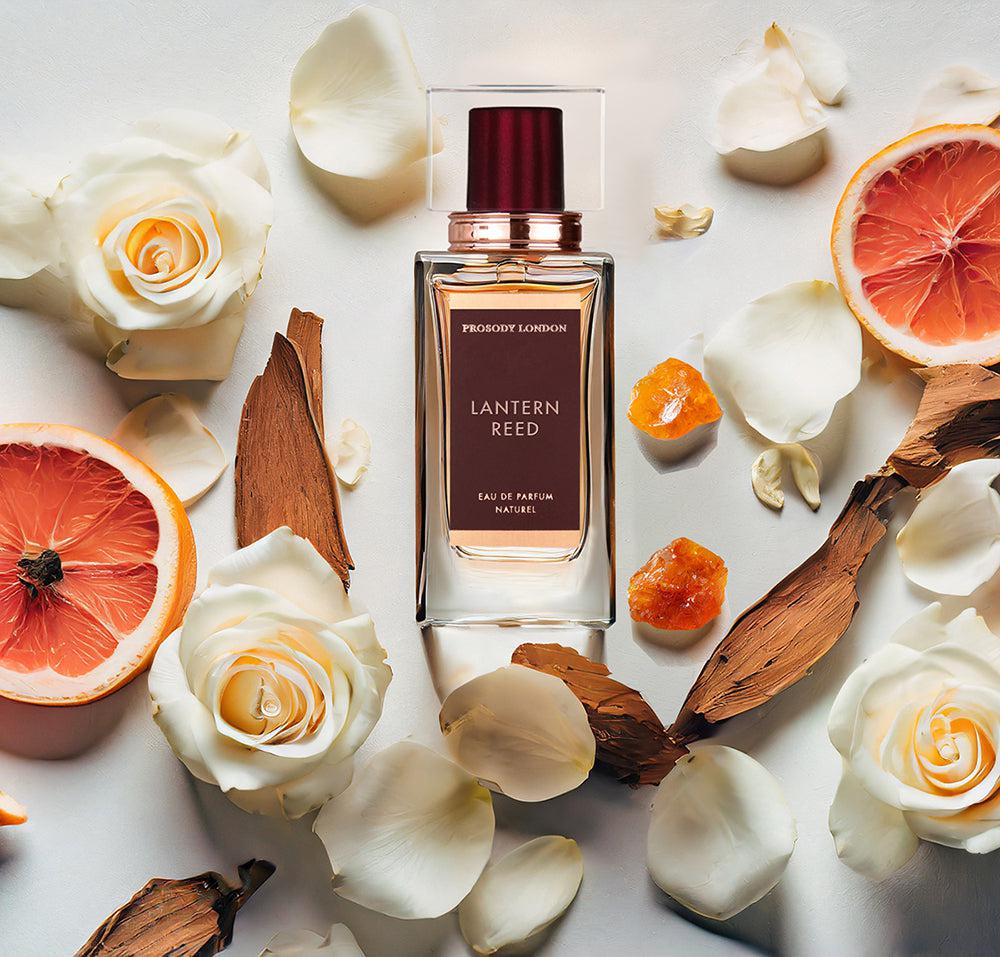
For those who want the faintest suggestion of powderiness rather than a full powdery signature, Lantern Reed is worth knowing about. It contains orris, which provides a whisper of powdery depth in the drydown — present enough to be felt, subtle enough to surprise. It is the least overtly powdery fragrance in the collection, but for wearers who find powdery perfume intense, it offers a way in.
The Difference That Sourcing Makes
Vanillin from rice bran fermentation and ambroxan from clary sage behave as natural materials do — they respond to skin temperature, skin chemistry, and time. The drydown of a Prosody fragrance on one person will be subtly different from the same fragrance on another. That variability is not a flaw. It is the point. Powdery perfume, at its best, is the smell of a fragrance becoming yours.
The original powdery tradition — built on orris root aged in Florentine fields, on natural vanillin, on mimosa and tonka and iris absolute — was always botanical. It was chemistry and commerce that made it synthetic. What we do at Prosody is not reinventing powdery perfume. We are returning it to where it came from.
If you are curious about how synthetic fragrance ingredients compare with natural ones, our fragrance vs scent guide covers the regulatory and formulation distinctions in detail. And if you want to understand what clean, non-toxic perfumery means beyond marketing language, our non-toxic perfume guide is the place to start.
If what you have been looking for is a powdery perfume you can wear with confidence — in every sense of that word — I think you have found it.
Explore the collection: Moiré Mimosa · Jacinth Jonquil · Neroli Nuance · Oud Octavo · Santal Foy · Rose Rondeaux · A Capella Ray · Ocean Commotion


