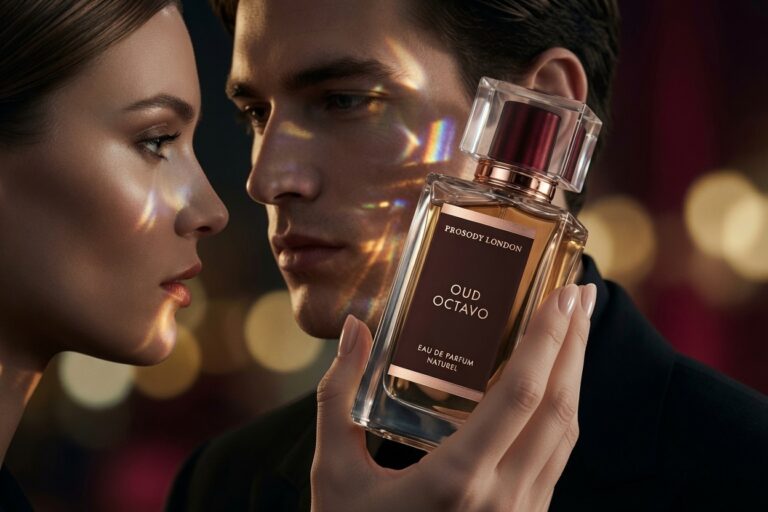
Natural Perfume for Arousal — A Working Perfumer’s Guide for Women
By Kershen Teo, Founder & Perfumer, Prosody London
The best natural perfumes for arousal are built on botanical ingredients that have been known for thousands of years. Vedic physicians classified jasmine, rose, and ylang ylang not as decorative ingredients but as medicines — prescribed for intimacy, emotional opening, and the restoration of ojas, the vital essence that governs sexual energy and radiance in Ayurvedic tradition.
Modern science is arriving at the same conclusions through a different door. Volatile aromatic compounds inhaled through the nose reach the olfactory bulb within milliseconds — the only sensory pathway with a direct line to the limbic system, bypassing rational thought entirely. This is why scent triggers desire faster than touch, and why the right botanical fragrance can lower cortisol, restore hormonal balance, and open the body to intimacy in ways that are both ancient and measurable.
As a perfumer who formulates exclusively from botanical ingredients, I work with these compounds every day. This is my guide to the botanical essential oils with the strongest evidence for female arousal — and the natural perfumes I’ve formulated that contain them.
Contents
- The botanical essential oils linked to female arousal — ranked by evidence
- Botanical perfume and the pheromone question
- Natural perfume, female fertility, and the endocrine system
- Women’s skin chemistry and natural oils
- Which natural perfume for arousal — by woman type
- How to wear natural perfume for arousal
- FAQ
The botanical essential oils linked to female arousal — ranked by evidence
Jasmine absolute (Jasminum grandiflorum & sambac)
Jasmine is the most powerful arousal-linked botanical in perfumery. Its indolic character — warm, animalic, almost skin-like — comes from indole, a compound structurally similar to certain human chemosensory signals. In Ayurveda, jasmine is divya — divine — and was used in bridal preparations, applied to pulse points, and burned in chambers of intimacy.
Clinical research confirms what Vedic physicians understood intuitively. Inhalation of jasmine essential oil significantly increases salivary testosterone concentrations while simultaneously elevating mood and arousal markers. It is the most extensively documented aromatic compound for direct effects on hormonal signalling through inhalation. → Phytotherapy Research – Komiya et al., 2006
Found in: Jacinth Jonquil (Jasminum grandiflorum) and Neroli Nuance (Jasminum sambac)

Ylang ylang (Cananga odorata)
Ylang ylang has been spread on marriage beds across Southeast Asia and Polynesia for centuries — the flower of intimacy, woven into hair, worn on skin, scattered in bridal chambers. Its Ayurvedic classification is sattvik — pure, clarifying, spiritually opening. It does not demand. It invites.
The clinical evidence is robust. Inhalation of ylang ylang essential oil lowers heart rate and blood pressure, reduces anxiety, and significantly increases feelings of sensual pleasure and emotional closeness. Its effect on the autonomic nervous system is parasympathetic — it moves the body from fight-or-flight into a state of openness and receptivity, which is the physiological precondition for female arousal. → Evidence-Based Complementary and Alternative Medicine – Hongratanaworakit & Buchbauer, 2006
Found in: Jacinth Jonquil and Paper Flower Fan
Rose absolute (Rosa damascena)
Rose is the flower of anahata — the heart chakra — in Vedic tradition, governing love, intimacy, and emotional connection. To anoint with rose was to prepare the heart, not merely the body. Rosa damascena absolute contains over 300 identified compounds including geraniol, citronellol, and nerol, which have demonstrated anxiolytic, antidepressant, and aphrodisiac properties in clinical settings.
Research shows rose absolute reduces cortisol and increases feelings of warmth, emotional safety, and sensual comfort — the conditions under which female desire naturally arises. Unlike synthetic rose reconstructions, genuine rose absolute delivers the full molecular complexity that produces these effects. → Evidence-Based Complementary and Alternative Medicine – Hongratanaworakit, 2009
Found in: Rose Rondeaux

Clary sage (Salvia sclarea)
Clary sage is the most clinically documented cortisol-reducing aromatic compound available in natural perfumery. Its primary active constituent, linalyl acetate, has been shown in controlled clinical trials to reduce salivary cortisol by up to 36% through inhalation alone — making it one of the most effective natural interventions for stress-blocked libido. For women whose desire is suppressed by mental load, anxiety, or exhaustion, clary sage addresses the root cause rather than the symptom. → Journal of Alternative and Complementary Medicine – Shin et al., 2014
In Ayurveda, herbs with linalool-dominant profiles are classified as vata-pacifying — calming the scattered, anxious energy that prevents presence and intimacy.
Found in: Neroli Nuance
Sandalwood (Santalum album)
Sandalwood is the quintessential Vedic aphrodisiac — present in almost every classical Indian aromatic tradition associated with intimacy, ritual, and the preparation of the body for sacred and sensual ceremony. In Ayurveda it is classified as ojas-building: it nourishes the vital essence directly, promoting deep calm, emotional warmth, and the physical relaxation that is the precondition for desire. Temple priests, brides, and lovers were all anointed with sandalwood paste for the same reason — it opens rather than stimulates, creates presence rather than urgency.
The clinical evidence supports this characterisation. Research confirms that sandalwood essential oil promotes significant relaxation, reduces anxiety, and elevates mood — with studies specifically noting its effects on emotional wellbeing and sensual comfort. Its primary active compound, α-santalol, has demonstrated sedative effects on the central nervous system through inhalation, lowering the physiological arousal of stress while simultaneously increasing receptivity and emotional openness. This dual action — calming the nervous system while deepening sensory awareness — makes sandalwood unique among aromatic aphrodisiacs. → Planta Medica – Hongratanaworakit, 2004
Unlike many luxury natural ingredients where the genuine article has been largely replaced by synthetic approximations, Prosody London uses genuine Santalum album in Rose Rondeaux — the same species used in classical Ayurvedic preparation, not the cheaper Australian or synthetic alternatives that dominate the mainstream market.
Found in: Rose Rondeaux
Labdanum (Cistus ladaniferus)
Labdanum is one of perfumery’s oldest ingredients — harvested from the cistus shrub of the Mediterranean since ancient times, referenced in the Old Testament, and used across Greek, Roman, and Vedic traditions as a material of ritual and intimacy. Its warm, resinous, amber-leathery character carries a subtle animalic warmth that sits close to the skin and deepens with body heat.
Three of the Prosody London fragrances in this guide contain labdanum as a base note — it is the fixative that grounds the composition and ensures the aromatic compounds evolve slowly and intimately on skin. Its presence in a fragrance is the difference between a scent that announces itself and one that becomes you. → International Journal of Aromatherapy – Buckle, 2004
Found in: Jacinth Jonquil, Rose Rondeaux, and Neroli Nuance
Neroli / orange blossom (Citrus aurantium)
In Vedic and Persian tradition, orange blossom was the scent of brides — worn on the wedding night as a symbol of anticipation, opening, and joy. Its warm, softly floral character comes from linalool and linalyl acetate — compounds with documented anxiolytic and mood-elevating properties in clinical settings. Combined with jasmine sambac in Neroli Nuance, it creates a composition that addresses both the cortisol barrier and the arousal pathway simultaneously.
The citation now links to the neroli randomised clinical trial — which is the correct and directly relevant study for this ingredient in this context.
Found in: Neroli Nuance

Ambrette seed (Abelmoschus moschatus)
Ambrette seed is nature’s own musk — warm, skin-like, and slightly animalic. Its macrocyclic musk compounds have been used for centuries in Ayurvedic medicine as a sensual tonic, promoting vitality and intimate allure. Unlike synthetic musks, which bioaccumulate in human tissue and have been associated with endocrine disruption, ambrette seed delivers its effect without hormonal risk — making it the only truly clean musk available to natural perfumery. → Journal of Ethnopharmacology – Lahlou, 2004
Found in: Carissis
Supporting essential oils for arousal
Several additional botanicals appear across the Prosody London portfolio with supporting roles in arousal and intimacy:
Cinnamon and ginger — vasodilators and circulatory stimulants, warming the body and increasing physical sensitivity. Present in Rose Rondeaux and Jacinth Jonquil respectively.
Cardamom — an Ayurvedic aphrodisiac and digestive tonic, adding aromatic warmth and sensual complexity. Present in Jacinth Jonquil.
Patchouli — earthy, animalic, and grounding, with a long history of use in Eastern perfumery as a sensuality enhancer. Present in Jacinth Jonquil and Rose Rondeaux.
Frankincense — deepens breathing, promotes meditative presence, used in Vedic ritual for spiritual and sensual opening. Present in Rose Rondeaux.
Benzoin — vanilla-like resin, skin-warm and emotionally comforting, used in love rituals across Southeast Asian tradition. Present in Neroli Nuance.
Lavender — the most effective botanical barrier-remover: calming the nervous system and clearing the anxiety that blocks desire. Present in Carissis. → International Journal of Neuroscience – Diego et al., 1998

Botanical perfume and the pheromone question
The word pheromone is often misused in fragrance marketing — implying that certain perfumes contain compounds that directly trigger attraction in others. The science is more nuanced than that, and more interesting.
Human chemosensory communication is real but not fully understood. What is documented is that certain aromatic compounds — particularly the macrocyclic musks found in ambrette seed, the indolic compounds in jasmine absolute, and the resinous warmth of labdanum — interact with the olfactory system in ways that produce measurable emotional and physiological responses. These are not pheromones in the strict biological sense. They are aromatic analogues — compounds that operate on similar neural pathways and produce similar limbic responses.
The Vedic understanding of this was intuitive rather than molecular. Gandha — scent — was understood as a direct communication between bodies, bypassing language and thought. The choice of aromatic materials for intimacy was not arbitrary: jasmine, labdanum, and musk-bearing plants were selected across multiple ancient traditions independently, suggesting a convergent understanding of their effect on the human nervous system.
What natural perfume does that synthetic perfume cannot is deliver these compounds without interference. Synthetic musks — galaxolide, tonalide, Iso E Super — project loudly but are metabolically inert. They do not evolve on skin, do not interact with body chemistry, and in the case of polycyclic musks, accumulate in tissue over time. Botanical musks like ambrette seed and natural labdanum evolve with the wearer — creating what perfumers call a third scent, the accord between the fragrance and the individual’s own chemistry. This is the closest thing to a genuine olfactive signature that perfumery can produce.
Natural perfume, female fertility, and the endocrine system
21:04
Claude responded: In Ayurveda, ojas is the finest product of digestion — the vital essence that governs immunity, sexual vitality, and radiance.
In Ayurveda, ojas is the finest product of digestion — the vital essence that governs immunity, sexual vitality, and radiance. It is produced when the body is in a state of balance: well-nourished, unstressed, emotionally open. Depletion of ojas manifests as fatigue, low libido, emotional flatness, and hormonal disruption. The restoration of ojas through aromatic plants — jasmine, rose, sandalwood — was understood as medicine for the whole reproductive system, not merely the mood.
Modern endocrinology supports this framework from a different angle. Chronic cortisol elevation — the physiological signature of sustained stress — suppresses the hypothalamic-pituitary-gonadal axis, reducing production of oestrogen and progesterone and directly impairing female sexual function and fertility. The botanical compounds with the strongest cortisol-reducing effects in clinical studies — clary sage, ylang ylang, rose, lavender — are precisely the ingredients that Ayurvedic tradition prescribed for the restoration of reproductive vitality. For a deeper look at how synthetic fragrance compounds work against this process, see our guide to endocrine disruptors in perfume.
This is not coincidence. It is convergent understanding across millennia and methodologies.

The endocrine disruption concern runs in the opposite direction for synthetic perfume. Phthalates — commonly used in conventional fragrances to extend longevity — are well-documented endocrine disruptors, linked in multiple studies to reduced oestrogen levels, impaired ovarian function, and disrupted menstrual cycles. A 2022 systematic review found phthalates in 24 out of 42 tested commercial perfumes. → Journal of Environmental Health Science and Engineering – Jafari et al., 2022
Synthetic musks present a further concern: galaxolide and tonalide bioaccumulate in adipose tissue, blood, and breast milk. Their structural similarity to hormones raises questions about long-term endocrine effects that conventional fragrance brands are not required to disclose.
A 100% botanical natural perfume eliminates every one of these compounds. It does not merely avoid harm — it actively delivers aromatic compounds that support the hormonal conditions under which female desire, vitality, and fertility naturally arise.
Women’s skin chemistry and natural oils
No two women smell the same fragrance identically—and this is not a marketing claim. It is skin chemistry.
Female skin tends to be slightly more acidic than male skin, with a lower average pH range. This affects the rate at which aromatic compounds volatilize—lower pH accelerates the top note phase and softens the projection of certain musks, while deepening the evolution of base notes like labdanum, benzoin, and sandalwood. A natural perfume formulated with high-quality base materials will evolve more richly on female skin for this reason. Ultimately, natural perfume doesn’t just sit on the skin; it collaborates with your unique biology to create a scent that is entirely yours.
Learn more about the science of botanical ingredients in our guide:What is Natural Perfume?
Oestrogen also influences olfactory sensitivity in documented ways. Women show measurably higher sensitivity to certain aromatic compounds—including musk-like molecules and indolic florals—particularly in the days around ovulation, when oestrogen levels peak. This is not incidental: heightened olfactory sensitivity during peak fertility is an evolved response, and it means that the same fragrance can smell more intense, more intimate, and more complex on female skin at different points in the cycle.
This has practical implications for how natural perfume performs. Synthetic fragrances are formulated for linear, consistent projection—they are designed to smell the same on everyone. Natural botanical perfumes are not. They are formulated with ingredients that respond to individual skin chemistry, evolving differently on every wearer. On female skin, particularly with the olfactory sensitivity shifts across the cycle, this evolution can be extraordinary—the same fragrance opening differently on Monday and Thursday, deepening in ways that a fixed synthetic composition never could.
The Vedic understanding of this was encoded in the concept of prakriti—individual constitution—which determines how a person responds to every input, including aromatic ones. A vata-dominant woman responds differently to jasmine than a kapha-dominant woman. A pitta constitution finds certain spiced compositions overwhelming that a vata would find grounding. The personalization of aromatic prescription in Ayurveda was not mysticism; it was an early framework for what we now understand as individual biochemical variation.
This is why the recommendation by woman type below is not arbitrary. It reflects both modern understanding of the nervous system and the ancient framework of constitutional medicine.
Which natural perfume for arousal — by woman type

If stress and mental load are blocking desire → Neroli Nuance
Clary sage and jasmine sambac address cortisol directly. Orange blossom lifts, clary sage quiets, labdanum grounds. The vata-pacifying composition for women whose minds won’t stop.

If you want direct sensory intensity → Jacinth Jonquil
The most densely aphrodisiac fragrance in the collection — jasmine grandiflorum, ylang ylang, cardamom, ginger, patchouli, and labdanum. Every note has a purpose. A pitta-stimulating composition: warming, energising, awakening.

If emotional connection and heart opening are what’s needed → Rose Rondeaux
Rose, sandalwood, cinnamon, frankincense, patchouli, labdanum. The most Vedic composition in the range — built for anahata, the heart chakra, for intimacy that begins emotionally before it becomes physical.

If you want parasympathetic calm and sensual openness → Paper Flower Fan
Ylang ylang at its purest — sattvik, clarifying, parasympathetically calming. For evenings, for slowing down, for presence without performance.

If anxiety is the barrier →
Carissis
Lavender and ambrette seed — the gateway fragrance. It removes the obstacle rather than stimulating directly. Wear this first, layer with Jacinth Jonquil or Paper Flower Fan if desired.
Explore the full natural perfume collection for women at Prosody London.
How to wear natural perfume for arousal
Apply to warm pulse points — wrists, throat, behind the ears, the inner elbow. Natural perfumes evolve with body heat; the aromatic compounds release gradually and deepen across hours rather than projecting immediately and fading. This slow evolution is not a limitation — it is intimacy. The scent becomes personal, a second skin.
In Ayurvedic practice, self-anointing with aromatic oils is itself a ritual of self-regard — abhyanga, the practice of self-massage, uses fragrant oils to calm the nervous system and restore prana before intimacy begins. The act of applying perfume with intention changes your relationship to your own body before anyone else encounters it.
Layer if desired: Carissis as a base, then Jacinth Jonquil over the top for jasmine and ambrette together. Rose Rondeaux over Paper Flower Fan for ylang ylang and rose in a classical accord of depth.
For further reading on the botanical ingredients behind these compositions, see our guide to essential oils for sexual arousal and perfumes that support libido.

FAQ on Natural Perfume for Arousal
What is the best natural perfume for female arousal? It depends on what is blocking desire. For stress and cortisol: Neroli Nuance. For direct sensory intensity: Jacinth Jonquil. For emotional connection: Rose Rondeaux. For parasympathetic calm: Paper Flower Fan. For anxiety as the barrier: Carissis. Each is formulated with botanical ingredients clinically linked to the specific pathway it addresses.
Do natural perfumes actually work for arousal? The research is on specific botanical compounds rather than perfume as a category. Jasmine, ylang ylang, rose, and clary sage have all shown measurable effects on cortisol and arousal markers in controlled clinical studies. A natural perfume formulated with these ingredients delivers them through the same inhalation pathway used in the research.
How does female skin chemistry affect natural perfume? Female skin chemistry — particularly pH and oestrogen-influenced olfactory sensitivity — affects how aromatic compounds evolve and are perceived. Natural perfumes respond to individual skin chemistry in ways that synthetic fragrances do not, creating a personalised evolution that deepens with body heat and shifts across the hormonal cycle.
Are natural perfumes safer than synthetic for hormonal health? Conventional synthetic fragrances often contain phthalates and synthetic musks associated with endocrine disruption. A 100% botanical natural perfume contains none of these compounds — it delivers aromatic benefit through botanical ingredients that support rather than disrupt the hormonal conditions linked to female desire and vitality.
What did Ayurveda say about perfume and female arousal? Vedic medicine classified aromatic plants by their effect on the doshas and on ojas — the vital essence governing sexual energy and radiance. Jasmine, rose, sandalwood, and ylang ylang were prescribed for intimacy, emotional opening, and the restoration of reproductive vitality. The convergence between these ancient prescriptions and modern clinical findings on cortisol, the limbic system, and hormonal signalling is one of the most compelling examples of traditional knowledge anticipating scientific understanding.

Ready to see how our scents collaborate with your biology? Explore the Full Collection
or Build Your Own Discovery Set.