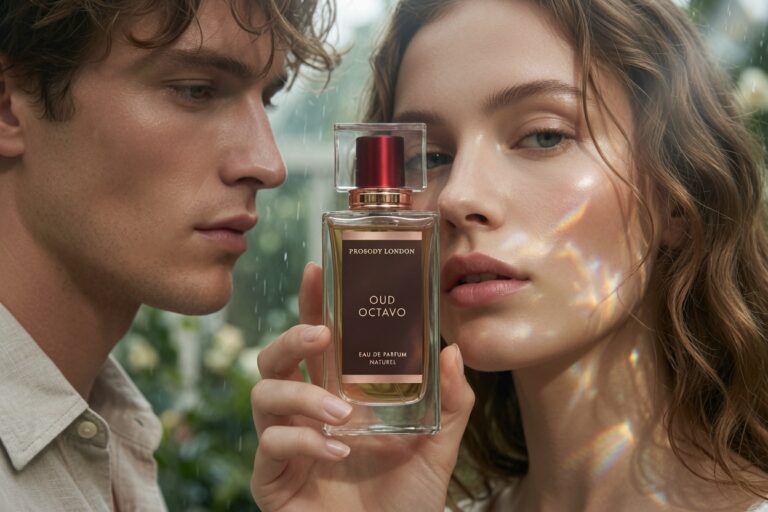
What is Natural Perfume 2026? Ingredients, Benefits and Longevity
By Kershen Teo, founder and natural perfumer of Prosody London
At a Glance — Natural Perfume vs Synthetic Perfume
| Natural Perfume | Synthetic Perfume | |
|---|---|---|
| Ingredients | Essential oils, absolutes, resins, CO2 extracts — no lab-created aroma molecules | Aroma chemicals engineered in a lab, often replicating natural scents at lower cost |
| Longevity | 4–12 hrs depending on composition, achieved through resinous base materials (agarwood, labdanum, myrrh) — resin- and oud-led formulas extend furthest, citrus and marine colognes sit at the shorter end | Often longer on fabric; achieved through polycyclic musks and phthalate fixatives |
| Skin Interaction | Evolves uniquely per wearer — skin pH, sebum, and microbiome co-author the scent | Engineered for consistency — smells near-identical across wearers |
| Regulatory Considerations | Free from phthalates, synthetic musks, and petrochemical fixatives | Some fixatives (e.g. galaxolide) are subject to a formal regulatory proposal for reproductive toxicity classification, with a separate ongoing assessment of potential endocrine-disrupting and bioaccumulative properties still underway (ANSES). |
| Sensitivity | Generally gentler; some citrus oils and oakmoss carry natural allergen caveats | Both natural and synthetic ingredients can trigger contact dermatitis; IFRA-compliant sourcing manages known allergens in either category. |
I have spent over a decade formulating exclusively from botanical ingredients. In that time I have been asked one question more than any other: what is natural perfume, exactly? Not the marketing answer — the real one. What makes it different, how it is made, why it behaves differently on skin, and whether it is genuinely worth choosing over a conventional fragrance.
This is my honest answer.
One scoping note before we go further: “natural perfume” has no single legal or universally agreed definition. In this article, it refers to perfume formulated exclusively from botanical aromatic materials — the standard Prosody London formulates to. Other brands using the word “natural” may follow different standards, some of which permit a percentage of synthetic ingredients or harmonisers. Worth asking any brand directly what they mean by it, ours included.
How Natural Perfume Is Made
The making of a natural perfume begins long before the formulation bench — it begins with sourcing.
The quality of a botanical fragrance is determined almost entirely by the quality of its raw materials, and raw material quality varies enormously. Steam-distilled rose absolute from Bulgaria smells different from Turkish rose. Indonesian vetiver has a different character from Haitian vetiver. CO2-extracted jasmine captures facets of the living flower that hexane-extracted jasmine absolute destroys in the extraction process.

I source from both large certified suppliers and small independent producers — family-run distilleries, traditional harvesters, growers with multi-generational knowledge of a single plant. Many of the finest producers in the world do not hold organic certification simply because the cost and administrative burden of certification is beyond the means of a small family operation. This does not make their materials less pure. Certification is valuable, but it should complement — not replace — direct supplier relationships and independent analytical testing. Knowing your producers directly, and being able to verify purity through nose and laboratory analysis, is how we build on what certification alone cannot guarantee.
Natural perfumery follows the material categories defined in ISO 9235:2021, the international vocabulary standard for aromatic natural raw materials — essential oil, absolute, concrete, resinoid, and related classes are precisely defined terms, not marketing language.
Once materials are sourced, formulation involves layering aromatic ingredients across a top, heart, and base structure — building a composition that evolves coherently from first spray through dry-down, with fixatives anchoring the formula to skin without the synthetic phthalates and musks that mainstream perfumery depends on. For a deeper explanation of how this works in the context of organic standards, see our organic perfume guide.

How Natural Perfume Is Made: The Extraction Methods
The raw materials of natural perfumery are as important as the formulation. How a botanical ingredient is extracted from its source determines the quality, complexity and integrity of what ends up in the bottle.
A 2021 review published in PMC examining essential oils as natural fragrance sources identified extraction method as a primary determinant of aromatic quality — with CO2 extraction consistently producing materials that more faithfully represent the living plant than conventional steam distillation.
Steam distillation is the oldest and most widely used extraction method. Plant material is exposed to steam, which volatilises aromatic compounds that are then condensed and collected. It is effective for robust materials — lavender, vetiver, cedarwood — but destroys heat-sensitive molecules, meaning the resulting oil is never quite identical to the living plant.
Cold pressing is used for citrus materials — bergamot, neroli, lemon, grapefruit. The rind is mechanically pressed to release the aromatic compounds. The result is a fresh, vivid material that captures the brightness of the fruit with no heat degradation.
Solvent extraction produces absolutes — the concentrated aromatic materials used for delicate flowers such as jasmine, rose and tuberose that would be destroyed by steam. The solvent is subsequently removed, leaving behind a rich, intensely aromatic wax that is then processed into an absolute. At Prosody London, we prefer CO2 extraction wherever practical because it avoids the use of organic solvents during extraction entirely.
CO2 extraction uses pressurised carbon dioxide to extract aromatic compounds at low temperatures, preserving the full molecular complexity of the source material. CO2 extraction often preserves a broader spectrum of volatile compounds than steam distillation, producing an aroma many perfumers consider closer to the living plant and more complex than steam-distilled equivalents.
Our jasmine CO2 smells closer to the living flower than any jasmine absolute I have worked with. CO2 vetiver has a freshness and green clarity that steam distillation rarely achieves. These materials cost significantly more — but the olfactory result is worth it.
Natural Isolates are single aromatic molecule separated from an essential oil via fractional distillation — geraniol from rose and geranium, vanillin from vanilla beans, coumarin from tonka bean. These are naturally occurring compounds, isolated rather than synthesised, and ISO 9235:2021 formally distinguishes them from both essential oils and synthetic aroma chemicals that merely replicate the same molecule in a lab. At Prosody London, isolates are used sparingly and only where the isolate itself — not a synthetic reconstruction — is the material in question.
Resinoids are produced by solvent-extracting plant exudates — balsams, gums, and resins — such as myrrh, olibanum, and galbanum. Distinct from an absolute, a resinoid captures the resin’s full aromatic complexity, including its characteristic depth and fixative quality. Resinoids are central to natural perfumery’s ability to achieve genuine longevity without synthetic fixatives — the same resins referenced throughout our longevity guides.
Tinctures & Infusions are produced by macerating a raw material — such as benzoin, myrrh, tonka bean or vanilla — directly in organic alcohol at variable concentrations over time, rather than through distillation or solvent extraction. Infusions work similarly using oil as the base. Both techniques are among the oldest in perfumery, predating industrial extraction methods, and remain in use at Prosody London for materials where a full tincture better preserves the material’s character than a concentrated absolute.
Enfleurage is the oldest extraction technique, in which fresh flowers are laid on fat that absorbs their aromatic compounds over time. It is rarely used commercially today due to the cost and time involved, but remains the reference method for understanding how botanical materials release their scent.

Why Natural Perfume Smells Different on Everyone
This is the quality of natural perfume that I find most genuinely interesting — and most poorly explained in most fragrance writing.
Perfume performance has traditionally been explained through skin chemistry — pH, sebum, moisture, and temperature. But these traits are heavily influenced by the skin microbiome: the community of bacteria, fungi, and other microbes living on the skin, which shape pH, lipid content, and hydration, and produce enzymes and acids that affect how fragrance molecules behave (Frontiers in Ecology and Evolution, 2023).
Skin bacteria are well documented to metabolise the skin’s own volatile compounds — the same mechanism behind body odour (Wiley — Decoding the Skin Microbiome’s Role in Odor Generation) — and closely related aromatic molecules also found in perfume, though direct study of bacteria acting on applied fragrance itself is still an emerging area. What this means in practice is that the fragrance you apply is not precisely the fragrance others smell — it is shaped, at least in part, by your personal microbial activity.
This matters more for natural perfume than for synthetic fragrance. Botanical materials are chemically complex — a single jasmine absolute contains hundreds of individual aromatic molecules, each interacting differently with skin temperature, sebum levels, and microbial activity. A synthetic fragrance built on a handful of aroma chemicals is engineered for consistency and predictability. A natural perfume built from botanical complexity is not — and that is its strength, not its limitation.
What this means in practice is that the same natural perfume can smell rounder and more sensual on warm, oily skin; lighter and more ethereal on dry skin; greener and more transparent in cool weather; warmer and more resinous in heat. The fragrance does not change — but your skin, temperature, and microbiome co-author the experience.
This is why I always recommend sampling before committing. Our natural perfume sample set exists precisely for this reason — to let you wear a fragrance through a full day on your own skin before deciding.

Natural Perfume vs Synthetic Perfume
Here’s Section 1 with the internal links embedded:
Natural Perfume vs Synthetic Perfume
The honest comparison is more nuanced than most natural perfumery brands will admit.
Synthetic perfumery achieves things botanical ingredients cannot — the crystalline transparency of certain aldehydics, the enormous skin-close projection of polycyclic musks, the year-on-year consistency that allows a mass-market fragrance to smell identical in every bottle. These are genuine technical achievements.
The trade-offs are ingredient transparency and health considerations. The synthetic fixatives that give mainstream fragrances their longevity — phthalates, synthetic musks such as galaxolide — have raised documented concerns in peer-reviewed research about endocrine disruption and environmental persistence. For a full account of the science, see our endocrine disruptors in perfume guide.
For a full breakdown of how natural and synthetic perfume actually compare on longevity, shelf life, cost, and projection, see the honest trade-offs below.
For a full side-by-side comparison, see our natural perfume vs synthetic perfume guide.
Is Natural Perfume Better for Sensitive Skin?
Good — here’s the restructured section with the two subheadings added, breaking up the density:
Is Natural Perfume Better for Sensitive Skin?
Not straightforwardly, and the honest answer is more nuanced than most natural perfumery brands admit. Natural perfume is free from phthalates, synthetic musks, and certain petrochemical-derived aroma chemicals that appear in conventional fragrance and are recognised causes of skin sensitivity. But that doesn’t make natural perfume universally hypoallergenic — it simply removes one category of risk while leaving others in place.
However, natural ingredients are not universally hypoallergenic. Certain citrus oils — bergamot, lemon, lime — can cause photosensitivity if applied to skin before sun exposure. Some floral absolutes contain naturally occurring allergens that IFRA monitors and restricts. Oakmoss and treemoss, among the most beautiful natural base materials in perfumery, are restricted under current IFRA guidelines because of their sensitisation potential in a small proportion of wearers.
At Prosody London, where oakmoss appears — in Neroli Nuance, for instance — we label it explicitly. Transparency about naturally occurring allergens is part of honest natural perfumery.
Fragrance allergy can arise from both natural and synthetic ingredients. Certain synthetic fragrance materials and certain naturally occurring constituents — limonene, linalool, citral, eugenol, oakmoss among them — are both recognised causes of allergic contact dermatitis. This is precisely why Prosody London sources exclusively from IFRA-compliant materials: IFRA sets restriction and labelling limits specifically for known natural allergens, not just synthetic ones, and working within those standards is how we manage this risk regardless of whether an ingredient is botanical or lab-made.
A Note on Limonene and Oxidation
It’s worth being precise about what actually causes sensitisation in a case like limonene, one of the most common natural allergens. Research shows it isn’t limonene itself that triggers most reactions, but the oxidation products — hydroperoxides — that form when limonene is exposed to air and light over time. This is why storage matters as much as the ingredient itself, and why IFRA sets specific limits on oxidised limonene content in finished fragrance.
The Quenching Question
There’s an interesting, related idea worth mentioning honestly rather than overselling: something researchers call “quenching.” Since the 1970s, contact-dermatitis studies have occasionally found that certain fragrance materials seem to reduce each other’s ability to trigger a reaction when they’re combined — rather than simply adding one risk on top of another (Investigation of the dermal sensitization potential of various essential oils in the local lymph node assay). It’s been shown experimentally for citral, and — closer to home for natural perfumery — one study found that limonene combined with eugenol reduced sensitization in most of the people tested, more than limonene did on its own (Exploring Pharmacological Mechanisms of Essential Oils on the Central Nervous System).
I want to be straight with you about this, though: researchers themselves note that due to conflicting data, quenching “has been replaced as a basis for risk management of contact allergy” for fragrance (Exploring Pharmacological Mechanisms of Essential Oils on the Central Nervous System). It’s a genuinely interesting open question in the research — not something we’d ask you to trust as a protective effect.
For people with fragrance sensitivity specifically, our natural perfume for sensitive skin guide covers what to look for and what to patch test before wearing.
The Honest Trade-offs of Natural Perfume
I would rather tell you the real trade-offs directly than let marketing smooth them over.
Shelf life (in the bottle)
The claim you’ll read everywhere — “natural perfume fades faster” — is an oversimplification when applied to shelf life, and in some cases it’s simply wrong. It depends entirely on which materials anchor the composition, not on whether those materials are natural or synthetic. Resins, woods, and heavy base materials like vetiver, oud, agarwood, labdanum, and patchouli don’t just resist degradation in the bottle — some may evolve over time, sometimes developing greater depth.
What genuinely does degrade faster are lighter, more volatile materials generally, and this cuts across both categories: citrus oils oxidise relatively quickly and can lose their brightness within a couple of years, and many aroma chemicals and isolates — natural or synthetic — are similarly short-lived, since it’s molecular volatility that determines instability, not origin. So bottle life in natural perfume isn’t a single number — it depends on which specific ingredients are doing the work. Store away from heat and light either way.
Longevity (on skin)
Here I’ll be direct: synthetic wins, hands down, especially against a fragrance built on synthetic musk. Musks such as galaxolide and tonalide are engineered specifically to persist on skin and fabric for as long as possible — that’s their entire purpose, and they do it more effectively than any natural material can. Base notes do function as fixatives in natural perfumery too, through the same molecular-weight principle — heavier, slower-evaporating materials like vetiver, oud, agarwood, and labdanum anchor a composition and give it real staying power, genuinely more than a citrus-forward natural fragrance would achieve alone.
But “more staying power than a lighter natural composition” is not the same claim as “competitive with synthetic musk.” It isn’t. If all-day, room-filling, still-there-tomorrow performance is the priority, synthetic fixatives remain the better tool for that specific job — and I’d rather say that plainly than let the resin argument oversell what it can actually do.
In terms of hours on skin, our formulas at Prosody London range from 4 to 12 hours depending on the fragrance and skin type — oud- and resin-based compositions like Oud Octavo and Rose Rondeaux sit at the longer end, while lighter citrus and marine colognes like Ocean Commotion perform closer to 4–6 hours. Applying to moisturised skin extends longevity significantly. For more on this, see our long-lasting natural perfume guide.
Cost
Natural absolutes, resins, and CO2 extracts cost meaningfully more than synthetic aroma chemicals of similar character — often many times over, sometimes running to hundreds or thousands of pounds per kilogram for the rarest materials. This is a genuine cost driver behind the price of natural perfume, not a premium added for marketing.
Consistency
A synthetic fragrance is engineered to smell identical bottle to bottle, harvest to harvest. A natural perfume depends on agricultural materials — rose, jasmine, vetiver — whose character shifts subtly year to year with weather, soil, and harvest conditions, the way wine does. Most people never notice. A trained nose sometimes will.
Projection
Synthetic musks are built specifically to fill a room and persist on fabric for days. Natural perfume, even at its most resinous, tends to stay closer to skin. If you want a fragrance that announces itself from across a room before you’ve entered it, that is a genuine synthetic strength this kind of perfumery doesn’t set out to replicate.
None of this makes natural perfume the wrong choice — it makes it a different set of trade-offs, and real ones. I’d rather you understand them precisely than discover them by accident.

What to Look for When Choosing Natural Perfume
Check the ingredient list for water (“aqua”) and for antioxidants such as BHT. Some water-containing fragrance formulations include antioxidants to help maintain the stability of certain fragrance ingredients during storage, and BHT is one of the best known used for this purpose. While BHT is approved for use within regulatory limits, it remains the subject of ongoing scientific debate. The Environmental Working Group (EWG), an environmental health advocacy organisation, assigns it a hazard score of 6 out of 10.
At Prosody London, our fragrances are formulated with high-concentration organic alcohol and without added water, so we do not use BHT or similar antioxidant stabilisers. Our paraben-free perfume guide explains our formulation approach in more detail.
Ask about extraction methods. CO2 extraction and steam distillation avoid the use of organic solvents during extraction. Where suitable CO2 alternatives exist, we prefer them because they align with our formulation philosophy — though properly purified commercial absolutes are subject to regulated residual solvent limits.
Be sceptical of the word “natural” without further qualification — it has no legal definition in cosmetics in either the UK or the EU. Ask whether the brand uses the synthetic allowance — under most voluntary natural fragrance standards, a perfume can contain a percentage of synthetic ingredients and still be marketed as natural. Ask directly whether any synthetics are present and why.
Be clear that “natural” is not the same claim as “vegan” or “sustainable.” “Vegan” only means a product contains no animal-derived ingredients — it says nothing about whether those ingredients are natural or synthetic. A perfume built entirely from lab-created aroma molecules, with zero botanical content, can still be 100% vegan. “Sustainable” is a different claim again, and often means the opposite of what “natural” implies: a genuinely sustainable ingredient might require no agricultural land at all — no rose fields, no vetiver crops, no trees tapped for resin — because it’s synthesised in a lab rather than grown. Natural perfumery, by definition, depends on real land, water, and harvests. Natural, vegan, and sustainable are three separate, sometimes conflicting claims — and a brand should be explicit about which one it’s actually making, rather than letting one word imply the other two.
Sample on skin before committing — no natural fragrance tells you anything meaningful on a strip or in a bottle. The interaction with your specific skin chemistry, temperature, and microbiome is the fragrance.

Discover Natural Perfume
Every Prosody London fragrance is 100% botanical — built on certified organic grain alcohol, formulated without water, free from parabens, phthalates, synthetic musks, and synthetic fixatives of any kind.
Prosody London Natural Perfume — At a Glance
| Fragrance | Type | Key Notes | Longevity |
|---|---|---|---|
| Oud Octavo | Eau de Parfum | Deep resinous oud, cedarwood, smoky amber | 10–12 hrs |
| Rose Rondeaux | Eau de Parfum | Rose, raspberry, patchouli, musky sandalwood | 9–11 hrs |
| Bebop Allure | Cologne Naturel | Cox apple, Bulgarian rose, vetiver, myrrh | 8–10 hrs |
| Jacinth Jonquil | Eau de Parfum | Jonquil absolute, hyacinth, jasmine | 7–9 hrs |
| A Capella Ray | Cologne Naturel | Bergamot, warm amber base | 4–6 hrs |
| Ocean Commotion | Cologne Naturel | Citrus, sea salt, marine botanicals | 4–6 hrs |
Not sure where to start? Our natural perfume sample set lets you try any six fragrances as 2ml samples — enough to wear each one through a full day before you decide.

FAQ on NaTural Organic perfume
What is natural perfume?
Natural perfume is fragrance made entirely from plant-derived ingredients — essential oils, absolutes, resins, tinctures, and botanical extracts. It contains no synthetic aromatic molecules, no petrochemical-derived fixatives, and no laboratory-created aroma chemicals. Because it is composed of botanically complex materials, it evolves uniquely on each wearer’s skin.
What is the difference between natural and synthetic perfume?
Natural perfume uses only ingredients derived from botanical sources. Synthetic perfume uses laboratory-created aroma molecules, often to replicate natural scents at lower cost or to achieve effects natural materials cannot. Synthetic fragrances are engineered for consistency and projection; natural fragrances evolve more interestingly and interact more intimately with individual skin chemistry. For a full comparison see our natural perfume vs synthetic guide.
Does natural perfume smell different on everyone?
Research confirms that skin bacteria metabolise many naturally occurring volatile compounds on the skin, and emerging evidence suggests they may also influence how applied fragrance develops after application — meaning the scent that develops on your skin may be shaped, in part, by your personal biology.
Is natural perfume better for sensitive skin?
It can be, depending on the cause of your sensitivity. Natural perfume avoids synthetic musks, phthalates, and other synthetic fragrance ingredients — but “natural” alone isn’t a guarantee, since allergens like limonene, linalool, citral, and oakmoss occur naturally too. What matters more is IFRA-compliant formulation, which sets safety limits specifically for skin sensitisation — and it’s worth knowing that many indie and niche fragrance brands don’t declare this at all. That’s the standard we formulate to at Prosody London, and we’re explicit about it.
Does natural perfume last as long as synthetic perfume?
Quality natural perfume ranges from 4 to 12 hours of wear on skin depending on composition — resinous, oud-based formulas like Oud Octavo achieve the longest wear, while lighter citrus and marine compositions like Ocean Commotion sit at 4–6 hours, still genuinely long-lasting for their style. It projects more quietly than synthetic fragrance and evolves more interestingly. Applying to moisturised skin significantly extends longevity.
How do I know if a perfume is genuinely natural?
Check whether the formula contains water (‘aqua’) and ask the brand how the fragrance is stabilised. Ask about extraction methods — CO2 extraction and steam distillation avoid organic solvents, while hexane does not, though properly purified commercial absolutes are subject to regulated residual solvent limits. Ask the brand directly to explain their formulation choices and why.
Can natural perfume contain parabens or phthalates?
A natural perfume built on high-concentration organic alcohol without water does not require parabens and should not contain phthalates.
Is Prosody London natural perfume genuinely natural?
Yes — completely. Every fragrance is 100% botanical, built on certified organic grain alcohol, formulated without water, and free from synthetic aromatic molecules, fixatives, preservatives, and musks of any kind. This is a structural property of how we formulate, not a label claim.