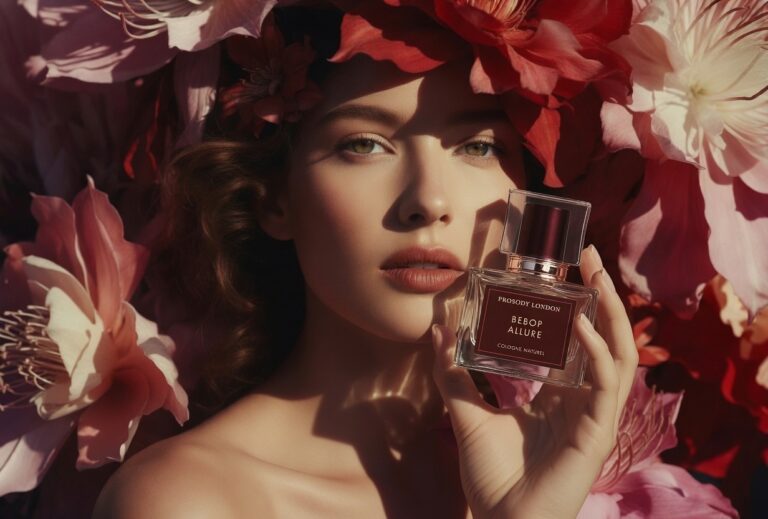
Is Natural Perfume Better for Sensitive Skin? | Science & IFRA Explained
By Kershen Teo | Founder & Perfumer, Prosody London
At a Glance — Is Natural Perfume Better for Sensitive Skin?
Natural perfume is generally better tolerated by sensitive skin than synthetic fragrance — but not automatically, and not unconditionally. The key distinction is formulation: synthetic musks such as galaxolide and tonalide bioaccumulate in human tissue with daily use and have been studied for endocrine-disrupting and skin-sensitising properties. Phthalates used as fixatives in conventional fragrances have been associated with skin barrier disruption. A well-formulated natural perfume removes these compounds entirely — but natural ingredients can still cause reactions if used above safe concentrations. IFRA compliance is the differentiating standard: it sets maximum safe concentrations for every botanical ingredient, ensuring that natural perfumes are both skin-beneficial and skin-safe. Prosody London fragrances are formulated to IFRA and Soil Association organic standards, using no synthetic musks, no phthalates, and no endocrine disruptors. For those with sensitive skin, the Build Your Own 6 x 2ml Discovery Set allows you to test each formula on your own skin before committing to a full bottle.
What Does “Sensitive Skin” Really Mean?
Sensitive skin is not a single condition but a heightened response to external stimuli. People with sensitive skin may experience:
- Redness or itching
- Burning or stinging sensations
- Headaches or nausea triggered by scent
- Delayed irritation hours after application
Fragrance is one of the most common triggers because it involves direct skin contact, inhalation, and neurological response. When considering is natural perfume better for sensitive skin, it’s essential to understand what the skin is exposed to and in what concentration. For the full picture on synthetic compounds that commonly trigger these reactions, see our guides to hidden chemicals in perfume and endocrine disruptors in perfume.
What Makes Natural Perfume Different?
Natural perfumes are composed of plant-derived ingredients such as essential oils, absolutes, and resins. These materials are chemically complex, often containing dozens or even hundreds of naturally occurring compounds that evolved together within the plant.
Synthetic perfumes, by contrast, are typically built from isolated aroma molecules, selected for consistency, strength, and longevity.
This difference matters because complex botanical ingredients tend to behave more gently on the skin, especially when used with restraint. Natural perfumes are often designed to sit closer to the body, evolving softly rather than projecting aggressively—an important factor for those with sensory or skin sensitivity. This characteristic may make natural perfume better for sensitive skin than synthetic alternatives.

Are Natural Perfumes Always Suitable for Sensitive Skin?
It’s important to be clear: natural does not mean non-allergenic.
Some botanical ingredients—particularly citrus oils, spices, and certain florals—can cause irritation in rare cases. However, these reactions are usually linked to concentration, oxidation, or poor formulation, rather than the ingredient simply being natural.
This is where professional formulation and safety standards become critical when evaluating whether natural perfume is better for sensitive skin in practice, not just in theory.
Understanding Limonene: A Common Concern
Ingredients such as limonene, found naturally in bergamot, frankincense, and citrus oils, are often flagged as potential allergens.
From a chemistry perspective, limonene is the same molecule whether it comes from a plant or is created in a laboratory. The difference lies in how it appears in a fragrance.
In natural perfume, limonene exists as part of a whole essential oil, surrounded by complementary compounds that help moderate absorption and volatility. In contrast, limonene used in isolation—especially at high concentrations—can behave more aggressively on the skin.
That said, the real issue with limonene is not its origin, but oxidation.
Oxidation: The Real Sensitivity Trigger
When limonene (natural or otherwise) is exposed to air, heat, or light, it can oxidise into compounds that are known skin sensitisers. This is why:
- Old or poorly stored perfumes can cause irritation
- Over-concentrated formulations increase risk
- Regulatory bodies require oxidised limonene to be declared
High-quality natural perfume mitigates this risk by:
- Using fresh, well-sourced essential oils
- Blending at skin-appropriate concentrations
- Packaging to reduce light and air exposure
- Reformulating when safety guidelines evolve
This level of care is far more important than whether a perfume is simply labelled “natural”.
The Role of IFRA Standards
One of the most important—and often overlooked—factors when asking is natural perfume better for sensitive skin is IFRA compliance.
The International Fragrance Association (IFRA) sets global safety standards sets global safety standards for fragrance ingredients based on toxicological research. These standards apply to both natural and synthetic materials and are designed to reduce the risk of irritation, sensitisation, and long-term skin reactions.
For sensitive skin, IFRA guidelines are essential.
Natural Ingredients Are Not Exempt from IFRA Rules
A common misconception is that natural ingredients can be used without restriction. In reality, many natural materials are strictly regulated by IFRA.
Ingredients such as:
- Bergamot and other citrus oils
- Oakmoss
- Clove and cinnamon
- Certain resins and florals
have maximum usage limits when applied to the skin. These limits are especially important for leave-on products like perfume.
IFRA compliance ensures that even beautiful, potent natural ingredients are used within safe dermal exposure levels.
Why Some Natural Perfume Brands Do Not Comply
An uncomfortable truth within the natural fragrance industry is that not all natural perfume brands, particularly small and artisan brands in the U.S., adhere to IFRA standards. While many consumers are drawn to the “purity” and “authenticity” of natural products, it’s important to understand that natural does not automatically mean safe—especially when it comes to sensitive skin.
This issue often arises for several reasons:
- The belief that “natural equals safe”: Many artisan brands operate under the assumption that because their ingredients are natural, they are inherently safe for all skin types. However, this belief can be dangerous. Even plant-derived ingredients can cause allergic reactions, irritation, or sensitization if not properly formulated or used within safe concentrations.
- A desire for stronger projection or longevity: Artisan brands often seek to create fragrances with longer-lasting scent profiles or stronger projection, which can sometimes lead them to use ingredients in higher concentrations than what is deemed safe for skin contact. While these scents may be more appealing to some consumers, they can increase the likelihood of irritation, especially for those with sensitive skin.
- Avoidance of reformulation costs: Reformulating a fragrance to meet IFRA’s guidelines can be an expensive and time-consuming process. For smaller brands, this may not be a top priority, particularly if they do not have the resources to invest in safety assessments or undergo rigorous testing. As a result, these brands may unknowingly or intentionally bypass regulatory limits to cut costs.
- Lack of formal safety assessment: Unlike large commercial brands with dedicated research and development teams, many artisan perfume makers do not have access to the expertise or resources needed to assess the safety of each ingredient in their formulations. Without formal safety assessments, there is a higher risk of exceeding safe usage thresholds for ingredients like citrus oils, spices, or other potent botanicals. Overuse of these ingredients can lead to adverse reactions, including irritation, redness, or even more severe allergic responses.
In some cases, natural perfumes may exceed recommended limits for citrus oils, spices, or other sensitizing ingredients, which can increase the likelihood of irritation—particularly for sensitive skin. Citrus oils, such as bergamot and lemon, can be phototoxic and lead to reactions when exposed to sunlight, while spices like clove and cinnamon can cause redness and stinging, especially if used in high concentrations. If these ingredients are improperly formulated or stored, the risk of irritation can escalate.
This means a perfume can be “100% natural” and still be poorly suited to sensitive skin. Just because a brand markets itself as “all-natural” doesn’t necessarily mean it adheres to safety standards or considers the potential risks for consumers. In fact, many small, artisan brands may lack the awareness or infrastructure to ensure their fragrances are IFRA-compliant, which can put consumers with sensitive skin at risk.
IFRA Compliance as a Marker of Quality
For people with sensitive skin, IFRA compliance is often more important than whether a perfume is natural or synthetic.
A responsibly formulated natural perfume will:
- Respect IFRA usage limits
- Adapt formulations as standards evolve
- Prioritise skin comfort over intensity
- Balance beauty with safety
This level of discipline reflects professional, luxury perfumery—not just aesthetic intent.
The Therapeutic Dimension of Natural Perfume: A Deeper Look
Natural perfumes have a relationship with the body that goes beyond scent alone — though it’s worth being precise about what that relationship is and isn’t. At the heart of this distinction lies the biological activity of essential oils and plant-based ingredients, which researchers have studied for various properties relevant to mood and wellbeing — not a claim that any fragrance, natural or otherwise, treats a medical condition. For the full breakdown of the research on specific botanical materials and skin, read our guide to perfume and skin.

Biological Activity and the Olfactory–Limbic Pathway
When we breathe in a natural perfume, the molecules of essential oils travel through the olfactory system and stimulate the limbic system in the brain. The limbic system is the part of the brain responsible for emotions, memory, and even physiological responses like heart rate and breathing. Because of this connection, the effects of essential oils can be profoundly therapeutic.
Ingredients like lavender, rose, frankincense, and bergamot have been studied for properties researchers describe as calming or mood-related. This is genuine and growing research, though it’s worth understanding its limits. For example:
Lavender has been studied for its relationship with anxiety reduction and sleep quality, with some research showing positive associations — though findings vary in strength and not all studies are conclusive. For the fuller evidence base on lavender and calming botanicals generally, read our guide to calming perfume.
Frankincense has been studied for compounds with anti-inflammatory activity in laboratory settings; this research is preliminary and doesn’t translate directly into a claim about wearing frankincense-containing perfume.
Bergamot has been examined in research exploring mood-related effects, including some studies looking at dopamine and cortisol pathways — interesting findings, not established clinical outcomes. For more on bergamot’s role in mood research, see our guide to perfume for mood and happiness.
Synthetic fragrances, engineered for consistency and mass production, are built from isolated molecules rather than the complex chemical profile of a whole botanical material. Whether this difference has meaningful biological consequences beyond scent is an area of ongoing research interest rather than settled fact — but it’s part of why I choose to formulate exclusively from botanical materials.

The Complexity of Natural Ingredients: Why Limonene Doesn’t Tell the Whole Story
A common argument from proponents of synthetic fragrances is that natural perfumes can be irritating or allergenic due to certain compounds, such as limonene, a naturally occurring molecule found in citrus oils. While it’s true that limonene can be a sensitizing agent in isolation, the full story is more complex—especially when considering is natural perfume better for sensitive skin.
When limonene is part of a whole plant extract, such as frankincense, bergamot, or lemon balm, it coexists with a variety of other antioxidants, terpenes, flavonoids, and other phytochemicals. These compounds work together to offer soothing, protective, and healing effects on the skin. This synergistic effect helps reduce the potential irritation that might occur if limonene were isolated or synthetically reproduced.
For example, frankincense contains limonene alongside boswellic acids and other compounds, which have been studied in laboratory settings for properties researchers describe as relevant to skin comfort. This research is generally conducted on isolated compounds rather than finished fragrance, and shouldn’t be read as a claim that frankincense-containing perfume treats or soothes any skin condition.
It is, however, part of why whole botanical materials are formulated differently from isolated synthetic molecules. For a closer look at frankincense, sandalwood, chamomile and other materials studied in relation to skin specifically, see our guide to perfume and skin.
The Quenching Question
There’s another genuinely interesting piece of this puzzle worth covering properly: something researchers call “quenching.” Since the 1970s, contact-dermatitis studies have found that certain fragrance materials can reduce each other’s ability to trigger a sensitisation reaction when combined — rather than simply adding one risk on top of another. This body of research is reviewed in detail in Tisserand & Young’s Essential Oil Safety, a standard clinical reference on essential oil pharmacology and safety.
The evidence spans several material pairs, tested across both animal and human studies:
- Citral, quenched by limonene. RIFM first reported this in 1976. It was confirmed in guinea pigs in 1983, then replicated in human volunteers in 2000 — and in a human repeat-insult patch test on 118 volunteers, 4% citral combined with 1% limonene produced no reactions at all. This finding is also supported indirectly: essential oils naturally rich in citral, such as lemongrass, were not sensitising when tested whole at concentrations where isolated citral was — and these oils naturally contain limonene alongside it. A separate large-scale patch-test survey similarly found citral’s sensitisation potential to be clearly dose-dependent, with no reactions at concentrations of 0.5% or below.
- Cinnamaldehyde, quenched by either limonene or eugenol — in one human study, limonene reduced the non-immunologic contact urticaria response in 3 of 11 cinnamaldehyde-sensitive subjects, while eugenol produced the same effect in 7 of the same 11 subjects. Follow-up work suggested that competitive inhibition at the receptor level may best explain the observed quenching phenomenon, although the precise mechanism remains uncertain.
- (R)-(−)-carvone, quenched by structural analogues, and separately by linalool — researchers noted this as possibly the clearest evidence for quenching yet, since linalool and carvone aren’t structurally similar, showing the effect doesn’t require the two materials to resemble each other chemically.
It’s worth noting that linalool itself sits on both sides of this conversation. It’s one of the 26 fragrance allergens the EU requires brands to declare on the label above a certain concentration — a real, mandatory disclosure. And yet the same material, as the primary component of lavender essential oil, has also been researched for anti-inflammatory and wound-healing-adjacent properties. Both facts are true simultaneously: mandatory allergen labelling doesn’t mean a material is without genuine benefit, and genuine benefit doesn’t exempt it from the sensitisation risk that mandates the label in the first place
The linalool ambiguity: Sensitiser or Skin healing
It is worth noting that linalool sits on both sides of this conversation. It is one of the fragrance allergens the EU Cosmetics Regulation Annex III requires brands to declare on ingredient labels above set concentration limits—a real, mandatory disclosure. Yet the exact same material, as a primary component of lavender essential oil, is widely researched for its anti-inflammatory and soothing properties. Both facts are true simultaneously: mandatory allergen labelling does not mean an ingredient lacks genuine benefit, and genuine benefit does not exempt it from the sensitisation risk that mandates the label in the first place. Linalool: A Review of Its Anticancer, Anti-inflammatory and Pharmacological Properties (PubMed)
Ultimately, a mandatory allergen label does not mean an ingredient is inherently dangerous—it means context matters. Pure, unoxidized linalool is well-tolerated; its oxidation products (hydroperoxides) are the true sensitizers. EU regulations manage pre-existing risks for sensitized individuals through mandatory label declarations, while IFRA Standards actively prevent new risks from developing by enforcing strict peroxide limits (under 20 mmol/L) and requiring antioxidant protection.
Does Neroli oil proves the quenching theory?
Neroli oil provides an interesting observation, though not proof, of this broader discussion. Neroli naturally contains both linalool and limonene—two fragrance materials that require allergen declaration under EU cosmetic regulations above specified concentrations. Yet the Environmental Working Group’s Skin Deep database assigns neroli essential oil a comparatively low hazard score of 2/10, while isolated linalool is rated 4/10 and isolated limonene 5/10.
At first glance, this might appear consistent with the idea that whole essential oils cannot always be understood simply by adding together the hazards of their individual constituents. However, these ratings should not be interpreted as evidence of a quenching effect. EWG’s Skin Deep scores are hazard assessments, not experimental measures of skin sensitisation or ingredient interactions, and they reflect factors such as concentration, available toxicological data, and exposure assumptions.
As such, neroli serves only as a hypothesis-generating example rather than proof that quenching is occurring. Demonstrating quenching would require controlled sensitisation studies directly comparing neroli oil with its isolated constituents under identical experimental conditions.
What this means practically: Quenching is a real, published, and repeatedly reported phenomenon for several specific fragrance-material combinations under experimental conditions. However, its applicability cannot be assumed for other ingredient combinations without direct evidence. Current evidence supports treating quenching as an area of ongoing research rather than a universally applicable property of fragrance mixtures. It should not be relied upon as a guaranteed protective effect, nor as a reason to skip patch testing or IFRA-compliant formulation.
A False Dichotomy: The Natural vs. Synthetic Debate
Critics of natural perfumes often highlight the potential irritants or allergens found in botanical ingredients, claiming that natural perfumes are too unpredictable or “unsafe” compared to synthetic fragrances, which are engineered for consistency. However, this black-and-white thinking overlooks the nuance of natural perfume for sensitive skin.
Yes, some natural compounds, like limonene, can be sensitizing, but the overall complexity of natural perfumes—with their combination of antioxidants, antimicrobial properties, and skin-nourishing compounds—provides therapeutic benefits that synthetic fragrances cannot replicate. These natural compounds have evolved over millennia, offering not just a scent but a skin-friendly experience.
In contrast, synthetic fragrances often contain chemicals like phthalates and synthetic musks, which have been linked to skin irritation, hormonal disruption, and other health concerns. Many synthetic fragrances are also derived from petroleum-based sources, which are neither sustainable nor as effective in providing the therapeutic benefits found in plant-based alternatives. Natural fragranes, on the other hand, avoid these synthetic additives and are often sourced from small-scale, fair-trade farms, promoting both sustainability and skin health.
In the end, whether natural perfume is better for sensitive skin depends less on the natural-versus-synthetic question alone and more on formulation discipline — IFRA compliance, fresh sourcing, appropriate concentrations — alongside the genuine absence of compounds like synthetic musks and phthalates that have their own documented concerns.
Choosing Natural Perfume for Sensitive Skin
If you have sensitive skin, consider the following when choosing a fragrance:
- Look for IFRA compliance
- Choose simpler compositions
- Avoid heavily citrus-forward scents if you know you’re reactive
- Apply lightly—natural perfume is meant to be intimate
- Patch test whenever possible
Many people with sensitive skin find unisex natural perfumes particularly suitable, as they tend to be balanced, understated, and skin-led. Patch test whenever possible. Our Build Your Own 6 x 2ml Discovery Set makes this easy — try several formulas before committing to a full bottle.

Final Thoughts
So, is natural perfume better for sensitive skin?
Often, yes—but only when it is thoughtfully formulated and responsibly regulated. Natural fragrance isn’t inherently gentler; it becomes gentler when it respects skin chemistry, ingredient limits, and international safety standards.
IFRA compliance, quality sourcing, and careful formulation are far more important than labels alone. When crafted with expertise and restraint, natural fragrance offers a quieter, more intimate, and often more comfortable fragrance experience—especially for those with sensitive skin.
If you’re looking for IFRA-compliant natural perfume, try Prosody London. Our fragrances are carefully formulated with respect for both the skin and the environment, ensuring a luxurious experience that is both safe and soothing.
For more insight into natural perfumes and how they can benefit your skin, learn more in our What is Natural Perfume? guide.
FAQ — Is Natural Perfume Better for Sensitive Skin?
Is natural perfume automatically better for sensitive skin than synthetic perfume?
Not automatically. Natural perfume tends to avoid synthetic musks and phthalates, compounds associated with skin sensitivity and tissue accumulation. But natural ingredients can still cause irritation if used above safe concentrations or poorly formulated. IFRA compliance, not the natural-versus-synthetic label alone, is the more reliable indicator of whether a fragrance is genuinely suited to sensitive skin.
What is IFRA and why does it matter for sensitive skin?
IFRA, the International Fragrance Association, sets global safety standards for fragrance ingredients based on toxicological research, including maximum safe concentrations for individual materials. These standards apply to both natural and synthetic ingredients. For sensitive skin specifically, choosing an IFRA-compliant fragrance is more protective than choosing a fragrance simply because it’s labelled natural.
Can natural perfume still cause skin irritation?
Yes. Some botanical materials, particularly citrus oils, spices, and certain florals, can cause irritation in rare cases, often linked to concentration, oxidation, or poor formulation rather than the ingredient being natural. Oxidised limonene, found in citrus oils when exposed to air, heat or light over time, is a known skin sensitiser regardless of whether the limonene originated naturally or synthetically.
Are all natural perfume brands safe for sensitive skin?
No. Not all natural perfume brands, particularly smaller artisan producers, formulate to IFRA standards. A fragrance can be entirely natural and still exceed safe usage limits for certain sensitising ingredients. Checking for explicit IFRA compliance is a more reliable signal of skin safety than the word “natural” alone.
How can someone with sensitive skin choose a natural perfume safely?
Look for explicit IFRA compliance, choose simpler compositions, apply lightly, and patch test before regular