Non-Toxic Clean Cologne for Men 2026 — A Perfumer’s Guide
By Kershen Teo | Founder & Perfumer, Prosody London
At a Glance — Non-Toxic Clean Cologne for Men 2026
This guide covers ingredients that have raised documented scientific and regulatory questions — synthetic musks, phthalates, and petrochemical derivatives commonly used across the designer fragrance industry— and presents 5 non-toxic clean alternatives from Prosody London: Ocean Commotion, A Capella Ray, Santal Foy, Lantern Reed, and Carissis. Full assessments below.
| Product | Type | Key Notes | Longevity |
|---|---|---|---|
| Ocean Commotion | Cologne Naturel | Marram grass, beechwood, kombu, Vesuvian lichen, agarwood | 4–6 hrs |
| A Capella Ray | Cologne Naturel | Sicilian lemon, black pepper, Bulgarian rose | 4–6 hrs |
| Santal Foy | Eau de Parfum | Mysore sandalwood, coconut, tonka bean | 6–8 hrs |
| Lantern Reed | Eau de Parfum | Bergamot, neroli, vetiver, cedarwood | 7–9 hrs |
| Carissis | Natural Skin Scent | Ambrette seed, violet leaf, styrax | 8–10 hrs, lighter and closer to skin |
Non-toxic clean cologne for men is not a compromise. A full fragrance profile is entirely achievable from botanical ingredients alone —no phthalates, no synthetic musks, and no synthetic fragrance ingredients associated with documented concerns around endocrine activity or bioaccumulation.
Most cologne contains ingredients I would never use. I make perfume for a living — 100% botanical, no synthetic shortcuts — and the gap between what goes into a mainstream fragrance and what the label tells you is wider than most men realise.
What’s actually in mainstream cologne?
Several ingredients that appear routinely in mainstream men’s fragrance have raised genuine questions in the scientific literature — not because they’re illegal (cosmetics sold in the UK/EU are regulated for safety at their permitted-use concentrations), but because the precautionary case for avoiding them, especially with daily lifetime exposure, is worth understanding.
Synthetic musks
Galaxolide and tonalide — the two most common synthetic musks in commercial cologne — are lipophilic, meaning they accumulate in fatty tissue. A 2005 study published in Chemosphere (PMID 15537743) detected both compounds in human blood and breast milk. They do not break down easily in the body or the environment. Every Prosody London fragrance is formulated without them.
Phthalates
Diethyl phthalate (DEP) is used in mainstream fragrance as a solvent and fixative. DEP has been investigated for potential endocrine activity in peer-reviewed research, although regulatory bodies differ in how they characterise its health significance at typical exposure levels.
Petrochemical derivatives
Some synthetic fragrance ingredients can trigger headaches or skin reactions in susceptible individuals — a reaction familiar to anyone who has walked through a department store fragrance hall. This isn’t universal to all petrochemical-derived materials, but it’s common enough to be worth knowing.
Other ingredients to watch for
Beyond synthetic musks and phthalates, several other fragrance chemicals are worth knowing. Iso E Super — a synthetic woody molecule widely used in designer cologne to add a smooth, ambery-woody quality. It’s not currently restricted in the EU, though as with most fragrance ingredients, IFRA sets concentration limits.
HICC (hydroxyisohexyl 3-cyclohexene carboxaldehyde, also known as Lyral) — a different synthetic material entirely, now banned in the EU for cosmetic use since 2019 due to its sensitisation potential, yet remains in use in non-EU markets. Musk ketone and musk tibetene — older nitro musks — have been largely phased out but occasionally appear in cheaper formulations.
None of these appear in any Prosody London fragrance. Some men with seasonal allergies or fragrance sensitivity find botanical colognes easier to tolerate than synthetic ones — frankincense in particular has been studied for its effects on allergic rhinitis. We cover this in our guide to frankincense for natural hay fever relief. For a full breakdown of hidden chemicals in mainstream perfume, read our guide.
What does “clean cologne” actually mean?
Nothing, legally. There is no regulated definition of clean fragrance. A brand can market a cologne as clean while it contains synthetic musks, undisclosed fragrance chemicals, and petrochemical solvents — all hidden behind the single word “fragrance” on the INCI list.
When I use the term non-toxic clean cologne for men, I mean something specific: fragrance formulated from 100% botanical ingredients in an organic grain alcohol base, with full ingredient transparency, no synthetic musks, no phthalates, and no petrochemical derivatives. That is a higher bar than the market uses. It is also the only definition I believe provides meaningful ingredient transparency.
Why mainstream cologne contains water
Water can create conditions that support microbial growth, so formulators must ensure the finished product is microbiologically stable. Depending on the formulation, that may involve preservatives, or rely on the preservative effect of a sufficiently high alcohol concentration.
The preservative problem
Water-containing formulas also often carry a separate ingredient doing a different job entirely: antioxidants that stop the fragrance oils themselves from oxidising in the bottle over time. BHT is one of the most widely used antioxidants for this purpose. It’s approved for use within regulatory limits, but it remains the subject of ongoing scientific debate — the Environmental Working Group (EWG), an environmental health advocacy organisation, assigns it a hazard score of 6 out of 10.
The case for a water-free base
Some researchers have raised the question of cumulative exposure when preservatives appear across multiple daily-use products — cologne, moisturiser, shampoo, shower gel — though the health significance of this cumulative pattern at typical consumer exposure levels remains an active area of research rather than settled fact. Prosody London uses organic grain alcohol with no water added — a water-free base that is structurally self-preserving, requiring no added preservatives of any kind. The alcohol itself is the preservative.
The 5 best non-toxic clean colognes for men 2026
I am a working perfumer. These are my own formulations — 100% botanical, made by hand in London. I include them here because I believe they represent some of the strongest non-toxic clean colognes available for men in 2026, and because I can stand behind everyingredient in every bottle.
Best clean cologne for everyday wear —
Ocean Commotion
→ Shop Ocean Commotion
A fresh aquatic cologne built entirely from botanical ingredients — no synthetic musks, no petrochemical derivatives.

The Vibe
Luxurious in its limpid purity — minimal and timeless on the surface, with an undercurrent of warm skin tone and quiet sex appeal. The rare agarwood expands as it lingers, turning a fresh aquatic opening into something richer and more unexpected.
Key Notes
Marram grass, beechwood, Vesuvian lichen, kombu, agarwood.
Why it’s for him
The longevity comes from agarwood and beechwood resin fixatives rather than synthetic musks — so it lasts without the chemical amplification that some people report as headache-triggering in mainstream aquatic cologne.

Best non-toxic cologne FOR THE SUN — A Capella Ray
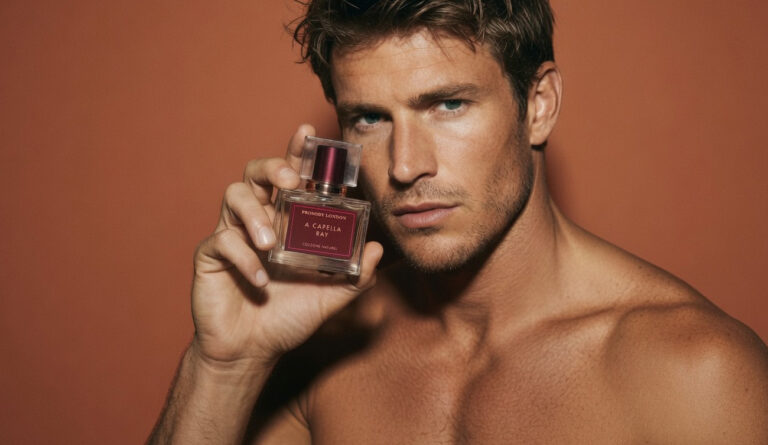
A Capella Ray is the one people ask about most. It creates the warm, skin-close character often associated with synthetic ambroxan using botanical materials, including clary sage, instead.
The Vibe
Solar citrus on the opening, dry and sophisticated in the heart, grounded by dark woody resonances — pure botanical notes stripped of synthetic fillers, vivid and breathable in a way that mainstream cologne rarely achieves.
Key Notes
Sicilian lemon, mandarin peel, black pepper, Bulgarian rose, bergamot, buddleia, lemongrass.
Why it’s for him
Most fresh-citrus colognes stay in one register — bright, then gone. A Capella Ray does something less common: lemongrass pulls the citrus opening into sharper, more masculine territory than lemon or bergamot alone usually manage, while the botanical amber base underneath keeps it warm and skin-close rather than fading out. That combination — genuinely masculine citrus with real depth underneath — is rare enough that it’s the detail people ask about most.
Best clean cologne for citrus that actually lasts — Lantern Reed
Most citrus colognes rely on synthetic fixatives to survive past the first hour — and even then, the result is a flat, linear freshness that never develops. Lantern Reed solves that problem with botanical materials instead.
The Vibe
Bright and sun-warmed on the opening — bergamot and neroli give it an immediate, luminous lift — before vetiver and cedarwood take over underneath, earthy and grounding materials with genuine tenacity that give the citrus somewhere to go rather than simply fading. The amber base adds warmth as the day progresses, so it moves from crisp to comforting rather than disappearing.
Key Notes
Bergamot, neroli, vetiver, cedarwood, amber.
Why it’s for him
Synthetic citrus fixatives can extend a fragrance’s life, but they tend to lock it into one flat note for the duration. Lantern Reed’s vetiver and cedarwood base does the same fixative job through genuine botanical tenacity — which means the fragrance actually evolves across the day instead of just persisting unchanged.

Best SUMMER skin-scent for men — Carissis
Technically not a cologne by concentration — Carissis is a natural skin scent, lighter and closer to the body than even an eau de toilette. I’ve included it here because for some men, that’s exactly the point: a fragrance so quiet it barely registers as “wearing scent” at all, just a warmth that sits on your own skin.
The Vibe
Soft, close, and almost private. Ambrette seed does the work synthetic musk usually does — often described as carrying “the memory of the deer,” a musk-like warmth with no animal origin at all — paired with violet leaf’s green intimacy and styrax’s warm resinous base. Melon and lavender open it gently before caraway adds a faint aromatic edge; rose and peach round out the heart. The effect is less “fragrance” and more “presence” — barely-there, skin-warm, private rather than projected.
Key Notes
Top: Melon, lavender, caraway. Heart: Styrax, rose, peach. Base: Ambrette seed, violet leaf.
Why it’s for him
Most “clean” alternatives to synthetic musk still try to project. Carissis doesn’t — built on ambrette seed rather than a lab-made musk substitute, it disappears into your own skin chemistry instead of announcing itself. It’s the most honest possible answer to “what does non-toxic musk actually smell like” without any synthetic amplification at all.
Best clean skin-scent for men who want something quieter — Santal Foy
Technically an Eau de Parfum, but Santal Foy wears with the lightness of a skin-scent — closer to the body than a cologne, more intimate than a statement fragrance.

The Vibe
Creamy, warm, and quietly addictive. Rare Mysore sandalwood — not a synthetic reconstruction like Javanol — merging with your own skin chemistry to create something genuinely personal. Coconut and tonka bean give it a milky, buttery softness that never tips into sweetness. “An evolving story that unfolds with each passing moment, leaving behind a trail of sophistication and mystery.” — Karl Topham, CaFleureBon
Key Notes
Coconut, carrot seed, tonka bean, Mysore sandalwood, Australian sandalwood, rose, myrrh, orange blossom, Madagascan vanilla.
Why it’s for him
Most sandalwood fragrances use synthetic santalol substitutes because genuine Mysore sandalwood is rare and expensive. Santal Foy uses the real thing — which is why it merges with skin rather than sitting on top of it, and why the dry-down is complex rather than flat.
Frequently Asked Questions — Non-Toxic Clean Cologne for Men
Is non-toxic cologne as long-lasting as mainstream fragrance?
Yes — if the formulation uses botanical resin fixatives. Agarwood, labdanum, benzoin, and galbanum are all botanical materials with exceptional fixative properties. Synthetic musks are one of the principal fixatives used to extend longevity in many mainstream fragrances because they evaporate very slowly. Botanical fixatives achieve longevity differently, through naturally resinous materials that slow evaporation and bind well to skin. The Prosody London collection ranges from 4 to 12 hours depending on concentration and composition — cologne-strength formulas like Ocean Commotion and A Capella Ray sit at 4–6 hours, eau de parfum formulas like Santal Foy and Lantern Reed at 6–9 hours, while Carissis, despite its quieter projection, wears for around 8–10 hours close to the skin.
Does non-toxic mean fragrance-free?
No. Non-toxic clean cologne for men has a full fragrance profile — it simply derives that profile from botanical ingredients rather than petrochemical synthesis. The olfactory experience is different from mainstream fragrance: richer, more complex in the dry-down, and without the sharp chemical edge that many synthetic fragrances produce.
Is botanical cologne safe for sensitive skin?
Botanical ingredients contain naturally occurring allergens — limonene, linalool, geraniol — which are declared on the INCI list. These are the same compounds that appear in fruits and flowers. They are not the same as the synthetic sensitisers found in petrochemical-derived fragrance molecules. Some people with fragrance sensitivity report finding botanical colognes easier to tolerate than conventional fragrances, although both natural and synthetic ingredients can trigger reactions in susceptible individuals. If you have a known fragrance allergy, patch testing is always advisable.ce.
What is the difference between natural and non-toxic cologne?
In this guide, ‘non-toxic’ describes Prosody London’s own formulation philosophy — avoiding ingredients that have raised documented questions in the scientific literature around endocrine activity, bioaccumulation, or sensitisation — rather than an established regulatory category. Like ‘clean,’ it has no legal definition, so it’s worth asking any brand what they specifically mean by it. In a well-formulated botanical cologne, the two terms tend to overlap.
The Prosody London Non-Toxic Clean Cologne Collection
Every fragrance in the Prosody London range is 100% botanical, formulated without synthetic musks, phthalates, or petrochemical derivatives. The base is organic grain alcohol. The ingredients are fully disclosed. If you are switching from mainstream cologne — or looking for the first time for something genuinely clean — the natural cologne sample set is the right place to start.