How to Make Natural Perfume in 7 Steps (Unisex Recipe)
By Kershen Teo, Founder & Perfumer, Prosody London — a 100% botanical fragrance house
At a Glance
What you’re making: how to make natural perfume that’s genuinely unisex — one fragrance (oil or alcohol base), built from 7 essential oils across top, middle, and base notes
Time: 15 minutes to blend, 24 hours to 2 weeks to rest and mature
Dilution: a low, skin-safe essential oil concentration, well within IFRA leave-on limits
See it done professionally: Prosody London’s own vetiver-forward Lantern Reed, and the ylang-forward natural cologne Paper Flower Fan, are useful reference points for how these same notes perform at full strength
Here’s how to make natural perfume that works for anyone: this a DIY unisex natural perfume project you could try at home. We’re using 7 simple essential oils you can get online easily or at your health food store, in one of the more approachable essential oil perfume recipes you’ll find — no perfumery training required.
These oils don’t just provide an array of delightful scents — many carry their own well-documented therapeutic associations, so the fragrance you end up with is as much a sensory ritual as it is a scent. This recipe is a guide to a reasonably long-lasting natural perfume oil: a light massage oil, a handy roll-on wherever you go. You can use alcohol instead of oil as well.
New to natural perfumery generally? Our full guide, What Is Natural Perfume?, covers how these oils are extracted, why the same blend smells different on everyone, and how natural perfume compares to synthetic — worth a read before you get started.
Understanding the Basics: Notes in Natural Perfume
Before diving into the recipe, it’s worth understanding “notes.” Every perfume — natural or otherwise — is built from three layers of scent that unfold in sequence as the fragrance meets skin and air.
Top Notes: the lightest and most volatile scents, smelled immediately after applying the perfume. They evaporate quickly, usually within the first 5–15 minutes, and set the first impression. Top notes are often fresh, crisp, or citrusy.
Middle Notes: these emerge as the top notes fade and form the “heart” of the fragrance. Middle notes make up the core of the perfume and last longer, usually 30–60 minutes. They’re typically rounder and more mellow, with floral or herbal scents common here.
Base Notes: the foundation of the perfume, providing depth and staying power. Base notes are richer and more intense, lasting for several hours, emerging slowly once the top and middle notes have dissipated. They’re usually woody, musky, or earthy.
A well-balanced perfume weaves all three together, creating a fragrance that evolves throughout the day.
Evaluating Odor Impact in Your Ingredients
Balance doesn’t mean equal amounts of each note. Some essential oils have a much stronger impact than others, so their effect on the overall fragrance is greater even used in smaller amounts. Base notes like vetiver and patchouli are very potent and long-lasting, so only a few drops are needed to give the perfume a strong foundation. In contrast, light and fresh top notes like grapefruit need to be used in larger quantities to be noticeable and to create a vibrant opening.
Ingredients You Need
This natural perfume formula uses the following essential oils:
Grapefruit Oil (Top note): a bright, citrusy essential oil that brings freshness and a zesty punch. It works well as a top note, providing an uplifting, energizing first impression.
Lemon Oil (Top note): a fresh, sharp citrus that adds an invigorating brightness, awakening the senses instantly.
Lavender Oil (Middle note): well-known for its calming, balancing properties. Its clean, floral aroma pairs beautifully with both the citrus top notes and the earthy, woody base.
Ylang Ylang (Middle note): a rich, floral oil that adds a sweet, exotic depth. It offers a soft, romantic aroma that balances and enhances the heart of the fragrance, bringing warmth and complexity.
Palmarosa Oil (Middle note): soft, floral, and slightly citrusy, with a lemongrass character — it adds warmth, depth, and a hint of sweetness to the middle note.
Vetiver Oil (Base note): a deep, earthy essential oil with a woody scent. It acts as a grounding base note, giving a perfume longevity and richness. Vetiver is associated with both masculinity and sensuality, making it ideal for unisex fragrances.
Patchouli Oil (Base note): strong and earthy, with an intense, lingering quality. Often combined with vetiver for a robust, long-lasting base.
Tools You’ll Need
For an alcohol-based natural perfume, a spritzer bottle that holds 40ml
7 pipettes for measuring essential oils. Swap the stock caps for pipette tops — it makes dosing far more precise, and each oil should have its own pipette to avoid cross-contamination.
A carrier oil (such as jojoba oil or fractionated coconut oil), or pure alcohol if you can get it. Don’t use vodka — it won’t dilute the essential oils very well. Both jojoba oil and fractionated coconut oil have a very long shelf life; I’ve had both stay usable for well over a decade, with fractionated coconut oil in particular showing almost no signs of going rancid.
A glass stirring rod or toothpick to blend the oils
A small glass beaker
A small, dark-coloured glass bottle (30ml) to store your perfume, plus a 10ml roll-on if you’re making the oil-based version
Unisex Natural Perfume Formula
This formula strikes a balance between fresh, floral, and earthy tones, creating a fragrance suitable for everyone, regardless of gender. Add the drops below into 40ml of your chosen base solvent.
| Note | Oil | Drops |
|---|---|---|
| Top | Grapefruit | 16 |
| Top | Lemon | 8 |
| Middle | Lavender | 8 |
| Middle | Ylang ylang | 4 |
| Middle | Palmarosa | 4 |
| Base | Vetiver | 8 |
| Base | Patchouli | 8 |

7 Step-by-Step Process
Final Touch: Once you’re happy with the scent, fill your final bottle or bottles.
Sterilize Your Bottle: Clean and sterilize the glass bottle in hot water. Make sure it’s completely dry before adding your ingredients, to avoid contamination.
Measure Your Carrier: Pour your carrier oil or alcohol into the glass beaker.
Add the Base Notes: Start with your strongest scents. Using your dropper, carefully add 8 drops of vetiver oil and 8 drops of patchouli oil into the bottle. Base notes are the most long-lasting components of your perfume, so make sure they’re well blended.
Add the Middle Notes: Next, add the heart of the fragrance. Add 8 drops of lavender, 4 drops of ylang ylang, and 4 drops of palmarosa. These scents become prominent once the top notes evaporate, giving your perfume warmth and character.
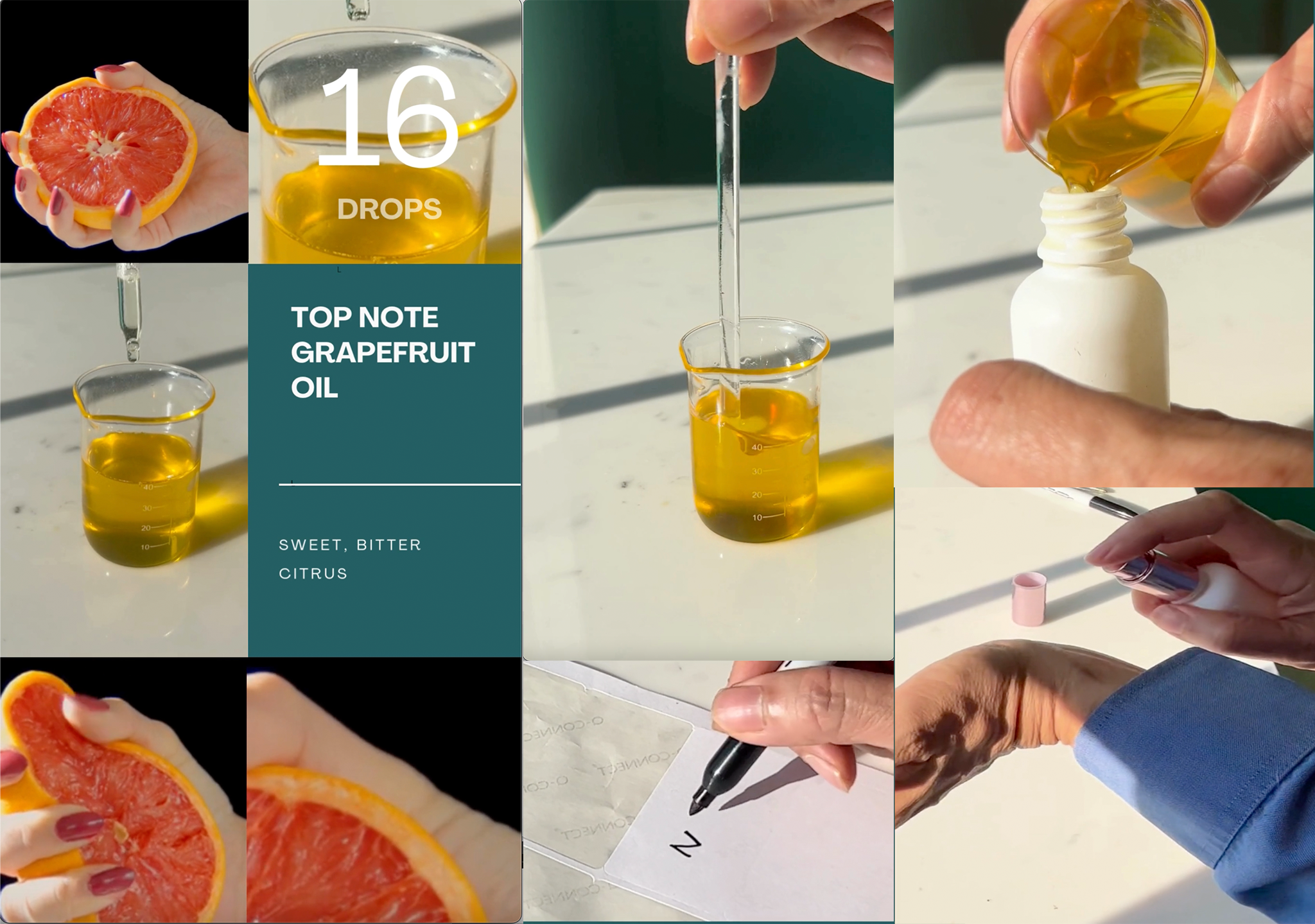
Add the Top Notes: Finally, add your top notes — grapefruit and lemon. Use 16 drops of grapefruit and 8 drops of lemon to create a bright, citrusy opening. Top notes are the first to evaporate, so a larger quantity ensures their presence is felt.
Blend and Test: After adding all your oils, stir gently with a glass rod or toothpick. Let the perfume rest for at least 24 hours, allowing the scents to meld and develop fully. The longer you let it sit — up to two weeks — the more the oils will blend and harmonize into a well-rounded perfume. Adjust if needed: after testing, adjust the formula to suit your preferences. Want more citrus punch? Add a few more drops of lemon or grapefruit. Prefer something deeper and earthier? Increase the vetiver or patchouli.

Why Is This Unisex Natural Perfume Well Balanced?
It’s not about having an equal number of drops at each note level — consider how each ingredient interconnects. The lemon bridges well with the palmarosa, continuing the zingy theme. The bitterness of grapefruit is driven by a molecule called nootkatone — which also occurs naturally in vetiver, giving the two oils a genuine chemical bridge as well as a stylistic one; together they build structure and longevity into the composition.
Top Tips for Making Beautiful Unisex Natural Perfume
The sophistication of this perfume depends heavily on the type of vetiver you use. Java vetiver leans quite smoky, with a coffee-like top note that can compete with the citrus opening. Haitian vetiver, if you can find it, is a much smoother product with a less intrusive top note — with it, you can push the vetiver quantity higher to make your unisex natural perfume last longer, without overwhelming the top note.
Safe Dilution for Unisex Natural Perfume
This composition sits at a low, skin-safe essential oil concentration suitable for leave-on application, whether you use an oil or alcohol base. But dilution isn’t something to eyeball by feel alone — it’s worth understanding properly before you start adding whatever smells good to you.
IFRA — the International Fragrance Association — publishes a maximum acceptable concentration for many individual fragrance ingredients, based on safety data reviewed by an independent expert panel. These limits exist because some materials, including a number of naturals, carry a genuine risk of skin sensitisation at higher concentrations: reactions that can build up with repeated exposure, sometimes to a material you’ve worn safely for years before it becomes a problem. Staying under the published threshold isn’t a bureaucratic formality — it’s the difference between a perfume that’s genuinely safe to reapply regularly and one that quietly builds a sensitivity over time, for the people you make it for and for yourself.
Ylang ylang in particular is a powerful note: for fine fragrance applied to skin, the IFRA Standard on Ylang Ylang Extracts caps it at 0.73% of the finished product — which is exactly why you rarely find a strongly ylang-forward perfume on the market outside of a cologne concentration. If you’d like to see that note pushed further, our Paper Flower Fan natural cologne is built around a much higher ylang ylang presence and is a useful reference point.
Every restricted ingredient has its own published limit, and you can look each one up directly in the IFRA Standards Library — search by ingredient name and check the figure for Category 4 (fine fragrance, hydroalcoholic products applied to skin), which is the relevant category for a perfume like this one.
Working out whether your actual formula stays under those limits takes more than counting drops, though. What matters is each restricted ingredient’s percentage of the total finished product by weight, not by drop count — a thin oil and a viscous oil at the same number of drops don’t weigh the same, so drop counts alone can be misleading. My advice: work out the formula you actually want first, based on what smells right to you — that instinct matters and shouldn’t be second-guessed away. Then go back and calculate each restricted ingredient’s real percentage in the finished product, and check it against its IFRA maximum before you finalise anything. A spreadsheet set up to convert drops to weight makes this manageable if you’re comfortable with that; if the maths isn’t your thing, ask someone with the right background to check it for you. Creativity comes first in building the composition — but working through IFRA’s guidance properly is what keeps that creativity safe.

When You’re Ready to Make Unisex Natural Perfume More Professionally
A common shortcut is measuring every note in equal drops. A more precise approach — the one used professionally — is to measure by weight rather than by drop count, since a single drop of a thin oil like ylang ylang carries far less mass than a drop of a viscous oil like vetiver.
It’s also partly about aesthetics: start from the base and build upward, then add to the top to make sure the opening is beautiful and not overwhelmed by the heart or base notes.
Beyond that, there are two ideas that professional perfumers think about constantly but rarely get explained to beginners.
Pro-Tip 1: The Concept of the “Blender”
When you smell your finished perfume, are you smelling individual notes popping out separately, or does it feel like one smooth, gliding composition? That’s the difference a “blender” makes — an ingredient whose whole job is to soften the transitions between other materials rather than announce itself. Think of a formula like a symphony: you don’t want individual instruments sticking out awkwardly, you want them moving together.
Lavender is a classic blender — it has a strong enough character of its own to round off sharper edges elsewhere in a formula. Sandalwood works the same way in the base, and bergamot does it beautifully in the top. Benzoin is another good one, smoothing a composition into a warm, balsamic whole rather than letting the base notes sit separately. Vetiver, to some extent, can act as a blender too, though it’s doing other structural work at the same time. Generally, materials with a strong, well-rounded character of their own tend to make good blenders, because they have enough presence to smooth whatever sits either side of them. As you build your own formula, it’s worth asking directly: what in this composition is actually creating that softness? If nothing is, that’s usually why a blend can smell like separate ingredients side by side rather than a single fragrance.
Pro-Tip 2: The Concept of the “Modifier”
Once you’re happy with a formula, it’s worth asking a different question: is there a tiny amount of something that would shift it and make it more interesting? A modifier is exactly that — a small, often high-impact addition that doesn’t change the character of the perfume so much as give it a twist.
Sometimes that’s a spice note. Sometimes it’s the tiniest amount of labdanum, or a touch of cognac oil. Galbanum is a good example of the type: a high-impact material where even a small amount can shift an entire formula noticeably. The skill is in looking at the range of ingredients available to you and asking which one, in a very small quantity, would make the composition more interesting without unbalancing it.
Conclusion
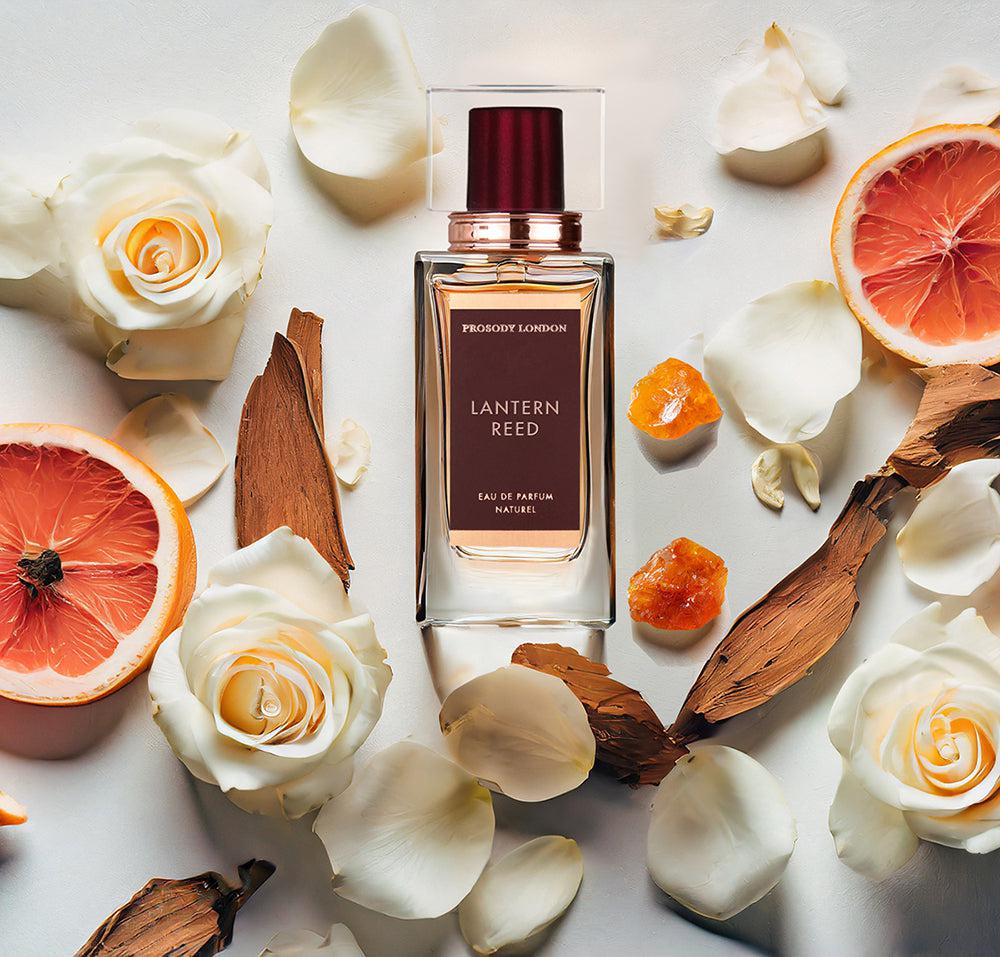
This unisex natural perfume formula is a rough guide — you can substitute palmarosa with geranium if you find palmarosa too harsh. You can add more vetiver if you want the perfume to last longer, though that will affect the soft top note, and sourcing good-quality vetiver is crucial to your success either way. For an example of a vetiver-forward perfume, take a look at Lantern Reed.
Prefer Not to DIY?
If measuring drops isn’t your idea of a relaxing afternoon, that’s exactly what Prosody London exists for. Every fragrance in the Natural Unisex Perfume collection is built on the same top/middle/base logic as this recipe — just formulated, aged, and balanced by a working perfumer rather than a home kit. Not sure where to start? Our Natural Perfume Sample Set lets you try six fragrances as 2ml samples before committing to a full bottle.
FAQ on how to make natural perfume
What makes a natural perfume “unisex”?
There’s no single ingredient that makes a scent unisex — it comes from the balance. Woody, earthy base notes like vetiver read as grounding rather than gendered, and pairing them with bright citrus tops and soft (rather than sweet) florals keeps the composition from leaning distinctly masculine or feminine.
Can I make this with alcohol instead of oil?
Yes. Use the same drop ratios, but blend into 40ml of a high-proof alcohol rather than a carrier oil, and use a spritzer bottle instead of a roll-on. Avoid vodka — its proof is too low to properly dissolve essential oils.
How long does a homemade natural perfume last on skin?
That depends heavily on your base note ratio. Vetiver and patchouli are the tenacious ingredients here; increasing them (within safe dilution limits) extends wear time, though it also pulls the composition further toward the earthy end.
Why does my natural perfume smell different a few days after blending?
That’s normal — it’s called maceration. The individual oils need time, typically 24 hours to two weeks, to bind and round out into a single, coherent scent rather than smelling like separate ingredients.
Is this dilution safe for skin application?
Yes — the formula above sits at a low, conservative dilution suitable for leave-on skin products. Always patch test first, particularly if you have sensitive skin, and be mindful of individually restricted oils like ylang ylang, which carry their own lower safe-use thresholds under IFRA guidance.