What Is Oud Made From? 8 Essential Facts About Agarwood
Oud is the most talked-about ingredient in contemporary perfumery — and also one of the most misunderstood. Brands from Tom Ford to Guerlain have built entire fragrance lines around it, yet the vast majority of what is sold as oud contains no real agarwood at all. As a natural perfumer who sources and works with genuine oud, I want to explain exactly what this material is, why it is so remarkable, and why it matters whether yours is real or synthetic.
1. What Is This Material, Exactly?
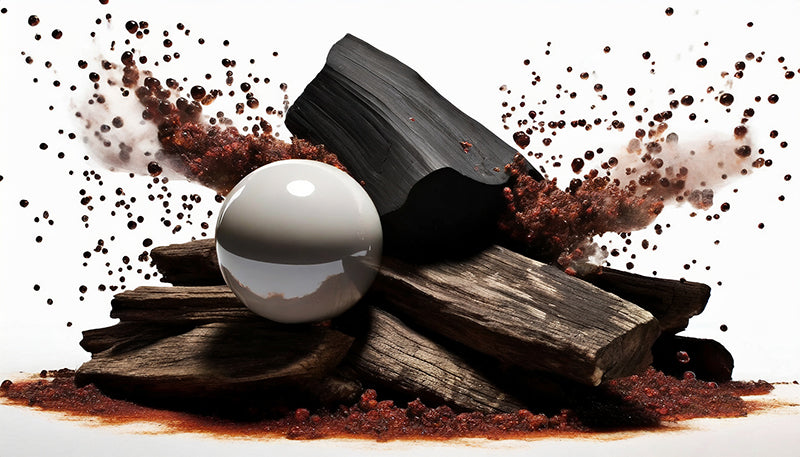
Oud — also known as agarwood — is a resinous heartwood formed inside the Aquilaria tree when it becomes infected by a specific mould, Phialophora parasitica. As a defence mechanism, the tree produces a dark, fragrant resin that gradually saturates the heartwood over years or even decades. It is this resin-soaked wood, and the essential oil distilled from it, that we call oud.
Before infection, the heartwood of the Aquilaria tree is pale, light and virtually odourless. The transformation from unremarkable timber to one of the world’s most complex aromatic materials is entirely driven by the tree’s response to disease. Only around 2% of wild Aquilaria trees ever produce agarwood — which is the fundamental reason for its extraordinary rarity and cost.
2. Where does agarwood come from?
Aquilaria trees grow across a band of tropical forest stretching from India and Bangladesh through Southeast Asia — Indonesia, Malaysia, Cambodia, Vietnam, Thailand — and into parts of the Middle East. Each region produces a distinctly different oil. Vietnamese oud, which I use in Oud Octavo, is considered among the finest — cleaner and more refined than many other origins, with a brightness that makes it unusually versatile for natural perfumery.
The geographic variation in oud is as significant as terroir in wine. Indonesian oud tends to be earthier and more animalic. Indian oud (often called Hindi oud) is famously barnyard-like in character — challenging but extraordinary in skilled hands. Cambodian oud is softer, sweeter, and more approachable. Understanding origin is essential to working with this material well.
3. Why is Agarwood so expensive?
Several factors converge to make genuine agarwood extraordinarily costly:
Rarity — only a small fraction of wild trees produce it, and formation cannot be reliably predicted or forced.
Time — high-quality agarwood requires decades of slow resin accumulation. Trees over 50 years old produce the finest material. You cannot rush this process.
Labour — extraction requires skilled workers who can identify infected heartwood and harvest it without destroying the tree. Done properly, it is painstaking work.
Regulation — all Aquilaria species are listed under CITES Appendix II as potentially threatened, meaning international trade requires documentation and sustainable sourcing verification. Ethical oud comes with a paper trail.
Demand — global appetite for agarwood has grown enormously over the past two decades, particularly in the Gulf states, driving prices further. Premium agarwood oil can reach £30,000–£40,000 per kilogram.
4. Why is most Agarwood perfume synthetic?
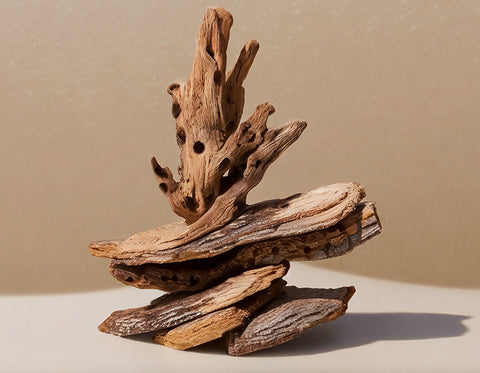
This is the question most brands prefer not to answer directly. The reality is straightforward: real agarwood at the concentrations needed to make a genuine oud fragrance is prohibitively expensive for mass-market production. A mainstream oud fragrance priced at £80–£120 almost certainly contains synthetic agarwood molecules — compounds like Iso E Super, cedarwood derivatives, or purpose-built agarwood reconstructions — rather than real oud oil.
This is not necessarily dishonest, and synthetic oud molecules have genuine value — they can be consistent, sustainable, and beautifully crafted. But it is a fundamentally different experience from a fragrance built on real agarwood, and consumers deserve to understand the distinction.
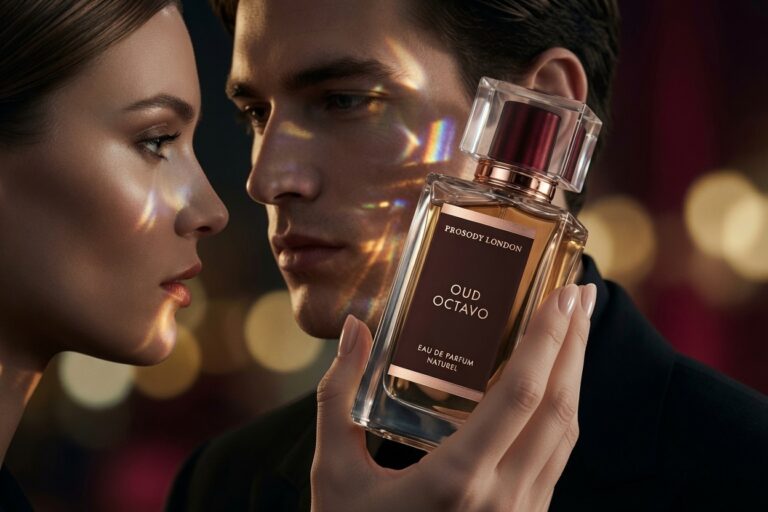
At Prosody London, Oud Octavo uses sustainably sourced real agarwood from Vietnam and Malaysia — at a concentration that makes a genuine difference to the character of the fragrance.
5. How to tell synthetic Agarwood from real agarwood
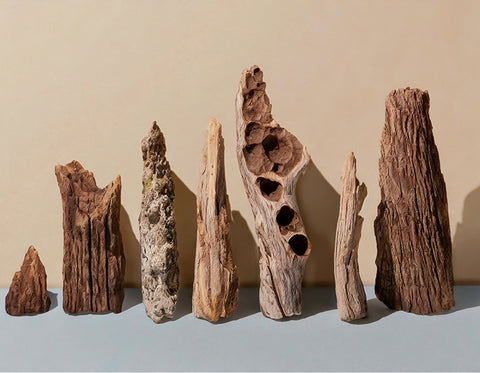
Distinguishing between real and synthetic oud takes experience, but there are reliable signals:
Complexity — real agarwood is extraordinarily complex. It does not smell like a single note — it shifts, it reveals different facets at different stages of wear, it has an almost living quality. Synthetic oud tends to be cleaner, simpler, and more linear.
Animalic depth — genuine agarwood has a quality that perfumers sometimes describe as barnyard, leathery, or animalic — particularly from Indian and Indonesian origins. This dimension is difficult to replicate synthetically and is often softened or removed in mainstream oud fragrances precisely because it is challenging for Western consumers.
Skin reactivity — like vetiver, real agarwood
behaves differently on different people. Its interaction with your skin chemistry is part of the experience. A synthetic agarwood projects more uniformly.
Longevity — genuine agarwood has exceptional fixative properties. A small amount anchors a fragrance for many hours. The longevity of a real oud fragrance tends to outlast its synthetic equivalent.
6. The cultural significance of agarwood
Agarwood has been used in fragrance and ritual for over three thousand years. The ancient Egyptians used agarwood incense in funeral rites. It appears in the Sanskrit Vedas as early as 1400 BCE. It is referenced in the Hebrew Bible, in the Gospel of John, and in the teachings of the Prophet Muhammad, who reportedly recommended its use as incense.
In the Middle East today, oud burning remains a central part of hospitality — guests are welcomed with the smoke of agarwood chips passed beneath their clothing. In Japan, the practice of kōdō — the art of appreciating incense — treats fine agarwood as an object of aesthetic contemplation. This cultural depth is part of what gives oud its resonance in perfumery far beyond its aromatic qualities alone.
7. Sustainability and the future of agarwood
The CITES listing of all Aquilaria species reflects a genuine conservation concern. Wild agarwood has been devastated by illegal logging in parts of Southeast Asia, and many of the oldest and finest trees — which produce the most complex resin — are now extremely rare in the wild.
The industry response has been the development of cultivated agarwood, where Aquilaria trees are deliberately inoculated with mould to trigger resin formation. Cultivated oud now accounts for the majority of legitimate agarwood in trade. It is generally lighter and less complex than wild oud, but it allows the material to remain available without further depleting natural forests. At Prosody London, we source only cultivated agarwood from verified sustainable producers.

8. How I use agarwood in Prosody London fragrances
Working with real oud as a natural perfumer is both a privilege and a challenge. Its intensity means it must be used with precision — too much and it overwhelms everything else; too little and its character is lost. In Oud Octavo, I wanted to create a fragrance where the oud was the clear protagonist — revealing its eight distinct facets through the composition rather than being subordinated to other notes. The result is built on Vietnamese and Malaysian agarwood, supported by cedarwood, cognac, angelica, clary sage, coriander seed, cistus, linden blossom, benzoin, styrax, labdanum, ginger and cinnamon.

Agarwood also appears as a supporting ingredient in Mocha Muscari and Ocean Commotion, where it contributes its fixative depth without taking centre stage.

If you want to experience what real agarwood smells like in a 100% natural composition, our Discovery Set includes Oud Octavo as a 2ml sample — enough to wear it through a full day and understand what makes this material unlike anything else in perfumery.