neroli nuance natural perfume for memory by prosody London with feather and rose

Natural Perfume for Memory — Huge Cognitive Boost Study

By Kershen Teo, founder and perfumer of Prosody London.

Perfume for memory is not a wellness trend. It is neuroscience — and the evidence behind it is more extraordinary than almost anyone in the fragrance world has noticed.

In July 2023, researchers at the University of California Irvine published a peer-reviewed study in Frontiers in Neuroscience that should have changed how we think about fragrance entirely. They exposed healthy adults aged 60 to 85 to natural essential oils through a bedside diffuser — just two hours each night — for six months. The result was a statistically significant improvement in memory and cognitive performance of a huge magnitude compared to the control group.

The researchers say the finding transforms the long-known tie between smell and memory into an easy, non-invasive technique for strengthening memory and potentially deterring dementia. UC Irvine News

If you have never heard of this study, there is a reason — and we will come to it. First, the science that makes it possible.

I’m Kershen Teo, founder and perfumer of Prosody London. Every fragrance in our natural perfume collection is made from 100% botanical ingredients — no synthetics at any stage of production. What follows is an honest account of what peer-reviewed research says about the relationship between natural botanical fragrance and memory, and which of our formulas contain the compounds that matter most.


Why Smell Reaches Memory Faster Than Any Other Sense — UC Irvine, Harvard Medical School and the Neuroscience

Every sense you have — sight, sound, touch, taste — routes its signals through the thalamus before reaching the brain’s emotional and memory centres. The thalamus is the brain’s relay station, filtering and directing sensory information before it reaches conscious awareness.

Smell does not work this way. Olfactory signals travel directly to the amygdala and hippocampus — the brain’s emotional and memory architecture — without any thalamic relay.

As Professor Michael Yassa, James L. McGaugh Chair in the Neurobiology of Learning and Memory at UC Irvine, explains: “The olfactory sense has the special privilege of being directly connected to the brain’s memory circuits. All the other senses are routed first through the thalamus. Everyone has experienced how powerful aromas are in evoking recollections, even from very long ago.” UC Irvine News

Harvard Medical School has independently confirmed this mechanism. Writing in Harvard Medicine Magazine — published November 2025 — HMS neuroscientist Sandeep Robert Datta describes how the olfactory system appears to have “essentially evolved to hardwire information to these memory and emotion centres.” Harvard’s research explains why odour-evoked memories tend to be more emotional and reach further back in life than memories triggered by any other sense.

As neuroscientist Rachel Herz at Brown University, who studies the psychological science of smell, states: “Smell can instantly trigger an emotional response along with a memory, and our emotional states have a very strong effect on our physical well-being.” Harvard Medicine Magazine

Harvard also adds a warning that strengthens the case for regular botanical fragrance use. Datta notes: “If we are suddenly denied our sense of smell, we feel adrift and confused about where we are in a way we didn’t expect. We’re constantly being reminded about where we’ve been and where we are through our sense of smell.” Harvard Medicine Magazine Scientists have found that loss of olfactory capacity predicts development of nearly 70 neurological and psychiatric conditions. The inverse is equally true — regular botanical fragrance exposure actively exercises the neurological system most directly connected to memory.

This anatomical shortcut is why a fragrance can transport you to a specific moment thirty years ago with an immediacy that a photograph or a song cannot match. It is not nostalgia. It is direct neurological wiring — confirmed independently by two of the world’s most recognised research institutions.


perfume for memory limbic system anatomy
Anatomical study of the olfactory-limbic interface. Highlighting the pathway from the Olfactory Tract to the Fornix and Hippocampal complex—the biological architecture behind scent-induced nostalgia.

The UC Irvine Study — What Actually Happened

The study enrolled male and female older adults aged 60 to 85 and randomly assigned them to an olfactory enriched or control group. Those in the enriched group were exposed to seven different natural odorants — one per night for two hours — using a bedside diffuser. Neuropsychological assessments and fMRI scans were administered at the beginning of the study and after six months. PubMed

The seven natural oils used were rose, orange, eucalyptus, lemon, peppermint, rosemary and lavender — all botanically derived, all present in natural fragrance formulation.

The results showed a statistically significant improvement in the enriched group compared to the control group on the Rey Auditory Verbal Learning Test — a standardised assessment measuring verbal learning and memory, including delayed recall, retention and recognition memory. PubMed Central

Among the control group, most participants stayed the same or got worse over six months — as expected with normal ageing. Among the olfactory enriched group, most stayed the same or improved substantially. The gap between the two groups was enormous — statistically significant with a large effect size.

But the structural finding is even more remarkable.

Brain imaging revealed better integrity in the left uncinate fasciculus — the brain pathway connecting the medial temporal lobe to the decision-making prefrontal cortex. This pathway becomes less robust with age and is directly associated with memory decline. ScienceDaily

The fragrance exposure was not just improving cognitive performance scores. It was physically strengthening the brain’s memory architecture — measurable on fMRI scans. Participants also reported sleeping more soundly — a secondary benefit that compounds the cognitive effect, since sleep is the primary mechanism through which memories are consolidated.


Why You Have Never Heard of This

The 2023 study caused something of a sensation when it was published in Frontiers in Neuroscience, attracting coverage from over 200 media outlets. UC Irvine News And then it largely disappeared — because science news has an extremely short cycle.

Nobody in the fragrance world connected it to what they were doing. The study was framed around cognitive decline prevention in older adults. It landed in neuroscience and gerontology circles, not in fragrance or wellness. The fragrance industry was not reading Frontiers in Neuroscience. Neuroscientists were not thinking about botanical perfumery.

To connect this finding to a natural fragrance brand you need to simultaneously understand neuroscience, botanical formulation and content strategy. Those three things do not usually exist in the same room.

The finding is also subtly disruptive for mainstream fragrance. If natural botanical scent has measurable neurological effects on memory and cognitive function, that raises uncomfortable questions about what synthetic fragrance does — or does not do — biologically. A synthetic molecule that mimics the smell of neroli does not contain linalool. A synthetic rose does not carry rose oxide’s serotonin pathway activity. The scent may be similar. The neurological effect is not.

For a detailed examination of why natural perfume triggers stronger memories than synthetic fragrance at a molecular level, read our dedicated article on natural perfume and memory formation.


The Botanical Compounds Most Linked to Memory — What the Science Shows

The UC Irvine study used seven natural oils. Five of the botanical families they represent have significant peer-reviewed evidence behind them for memory and cognitive function. All five are present in Prosody London formulas.

BotanicalKey compoundMemory mechanismProsody London products
Rosemary1,8-cineoleAcetylcholinesterase inhibition, cognitive performance and recall speedMona Lisa diffuser
Neroli / orange blossomLinaloolHippocampal neurogenesis, memory circuit structural integrityNeroli Nuance, Whistle Moon, Bebop Allure
RoseRose oxide / serotonin pathwayEmotional memory encoding and consolidationRose Rondeaux, Bebop Allure
Sandalwoodα-santalolParasympathetic activation, cognitive claritySantal Foy
FrankincenseIncensole acetateTRPV3 channel activation, emotional regulation, neuroprotectionOud Octavo
LavenderLinalool / linalyl acetateGABA modulation, memory consolidation during sleepMocha Muscari, Carissis
BergamotLimonene / linaloolCortisol reduction, dopamine activation, active recallLissom Linden
rosemary perfume for memory with gold plate and crystal

Rosemary and 1,8-cineole — the cognitive performance compound

Research from the Brain, Performance and Nutrition Research Centre at Northumbria University showed for the first time that performance on cognitive tasks is significantly related to the concentration of absorbed 1,8-cineole following exposure to rosemary aroma, with improved performance at higher concentrations. PubMed Central

Extracts of rosemary display significant inhibitory effects on acetylcholinesterase enzymes — the same biochemical pathway that underpins the pharmacological activity of a number of dementia treatments. PubMed Central A further Northumbria study found participants in a rosemary-scented room performed better on prospective memory tasks — remembering events, completing tasks at particular times, and speed of recall — than those in an unscented room.

Neroli and linalool — hippocampal neurogenesis

Linalool — the primary molecule in neroli and orange blossom — has documented effects on hippocampal neurogenesis, the process by which new neurons form in the brain’s primary memory centre. This is directly relevant to the uncinate fasciculus improvements observed in the UC Irvine fMRI data — linalool supports the structural integrity of the very brain pathways the study showed natural fragrance strengthening.

perfumes men love on women - hand touching rose petals

Rose — emotional memory encoding

Rose absolute’s interaction with serotonin pathways has particular relevance to memory — specifically to emotional memory encoding. Emotionally significant memories are encoded more deeply and retrieved more readily than neutral ones. The serotonergic activity of rose compounds enhances the emotional salience that determines which memories persist and which fade.

Frankincense — the ancient memory compound

Research published in the FASEB Journal demonstrated that incensole acetate, a constituent of Boswellia resin, is a potent TRPV3 channel agonist that causes anxiolytic-like and antidepressive-like behavioural effects, with the researchers concluding that TRPV3 channels in the brain may play a role in emotional regulation. PubMed Central

Frankincense was used by the physician Avicenna in the 10th century to prevent amnesia and improve memory. Contemporary research confirms that incensole acetate and boswellic acid can have a positive effect on brain development and on the formation of dendrites and axons and improving their communication. PubMed Central

The fact that frankincense has been burned in temples, churches and ritual spaces across every major civilisation for millennia is not coincidence. The neurological basis for why it produces altered states of awareness and heightened emotional presence has now been identified in peer-reviewed research.

Sandalwood — cognitive clarity

Sandalwood’s documented effect on parasympathetic nervous system activation creates the cognitive conditions most conducive to memory formation and retrieval — a calm, alert state rather than an anxious or fatigued one. Memory consolidation and retrieval are both impaired under stress. Sandalwood directly addresses the physiological obstacle.

Lavender — memory consolidation

Linalool and linalyl acetate — the primary active molecules in lavender — support GABA receptor activity and the consolidation of memories during rest. The UC Irvine study used lavender as one of its seven nightly botanical oils specifically because of lavender’s documented role in memory consolidation during sleep.

Bergamot — bright memory and active recall

Where lavender and sandalwood support memory through rest and consolidation, bergamot supports it through the quality of attention brought to the present moment. Bergamot’s limonene and linalool content produces documented cortisol-lowering and dopamine-activating effects — creating the bright, calm alertness under which working memory and active recall perform best.


The Mona Lisa Diffuser — Applying the UC Irvine Protocol

The UC Irvine finding is most directly applicable through diffusion during sleep. Two of the seven oils used in the study — rosemary and neroli — are combined in the Mona Lisa diffuser blend from Prosody London.

Rosemary provides the 1,8-cineole with the most direct clinical evidence for cognitive performance and memory speed. Neroli provides the linalool with evidence for hippocampal neurogenesis and memory circuit integrity. Used together in a diffuser for two hours nightly, Mona Lisa is the most direct botanical application of the UC Irvine research available.

One important note — the UC Irvine protocol used short, defined bursts of olfactory stimulation, not continuous all-night exposure. One to two hours per session is the optimal window. The brain responds to novelty and habituates to constant background scent — short bursts stimulate memory circuits far more effectively than persistent exposure. Think of it like putting on your favourite record rather than leaving it on loop all day. Run the diffuser for the first hour or two of sleep and cap it with a timer.

For a full guide to using room fragrance and diffusion for memory — including how to apply the UC Irvine protocol at home — read our dedicated article on room fragrance for memory.


natural reed diffuser set by prosody london on marble and fruit plater

Prosody London Perfumes for Memory — Wearing the Evidence

Beyond the diffuser, the same botanical compounds that produce memory effects through diffusion are present in our wearable fragrances. The olfactory system’s direct connection to memory circuits does not switch off when you are awake — every time you inhale the botanical compounds in a natural fragrance worn on skin, those molecules are reaching your hippocampus directly.

neroli nuance by prosody london organic perfume with orchis and orange background

Neroli Nuance → Memory Circuit Support

Perfume for memory begins here. Built entirely around neroli and orange blossom absolute — the richest botanical sources of linalool with the most direct evidence for hippocampal neurogenesis — Neroli Nuance provides continuous low-level olfactory stimulation from the compound most directly associated with the structural memory improvements observed in the UC Irvine fMRI data. As Jo Fairley wrote in the Daily Mail: “super-elegant, summery” — and Liz Earle has cited it as her favourite fragrance. The science explains precisely why it affects the brain the way it does.

whistle moon perfume for memory

Whistle Moon → Neroli in a Lighter Register

Whistle Moon is our neroli-led cologne formula — the same linalool-rich botanical compound as Neroli Nuance, delivered in a lighter, fresher register. For those who prefer a more diffuse formula for daytime wear, Whistle Moon provides the same memory-relevant botanical activity continuously without asserting itself loudly. As a perfume for memory worn throughout a working day, it delivers neroli’s neurological activity in a form that works at any hour.

prosody london bebop allure organic cologne with pink florals

Bebop Allure → Rose and Neroli Combined

Bebop Allure brings together the two botanical families with the strongest combined memory evidence — rose and neroli — in a single formula. Rose’s serotonin pathway activity for emotional memory encoding alongside neroli’s linalool for hippocampal neurogenesis. This is the perfume for memory that addresses two distinct mechanisms simultaneously — encoding emotional significance and supporting structural memory integrity in the same wear.

prosody london rose rondeaux long-lasting niche perfume with rose

Rose Rondeaux → Emotional Memory

Bulgarian rose absolute lies at the heart of Rose Rondeaux. Rose’s interaction with serotonin pathways makes it the botanical most directly associated with emotional memory encoding — the process that determines which experiences are stored deeply and which are forgotten. Rose Rondeaux is perfume for memory in the most personal sense — the kind of fragrance that becomes inseparable from the moments in which it is worn, because it is actively enhancing the neurological process of encoding those moments as they happen.

mocha muscari best oud perfume in green marble and roman bust

Mocha Muscari → Memory Consolidation

Lavender absolute runs through Mocha Muscari — rich in linalool and linalyl acetate, the compounds that support GABA receptor activity and memory consolidation during rest. In Mocha Muscari this memory-relevant compound arrives wrapped in dark mocha and labdanum — one of the most distinctive and therefore most memory-anchoring formulas in the collection. Distinctiveness matters for memory encoding: the more unusual and multisensory a fragrance, the more deeply it registers as an autobiographical memory marker.

carissis by prosody london natural perfume for anxiety with tulip

Carissis → Quiet Memory

Carissis carries the same linalool-rich lavender absolute as Mocha Muscari — the compound with documented effects on GABA receptor activity and memory consolidation — but delivers it in an entirely different register. Where Mocha Muscari is dark and roasted, Carissis is intimate and skin-close, the carissa blossom softening the lavender into something that reads as your own scent rather than a perfume worn on top of it. This intimacy is itself memory-relevant — skin-close fragrances create more personal, more distinctive olfactory memories than loudly projecting ones. Carissis is the perfume for memory that becomes hardwired to you specifically, rather than to a moment or place.

Phthalate-Free Perfume UK santal foy by prosody london lady with white florals

Santal Foy → Cognitive Clarity

Sandalwood’s documented effect on parasympathetic nervous system activation creates the cognitive conditions most conducive to memory formation and retrieval. Memory consolidation and recall are both impaired under stress and enhanced under calm alertness. Santal Foy delivers this state consistently across hours of wear — creamy, warm and deeply grounding, it is the formula most suited to wearing during focused work or study when memory encoding matters most.

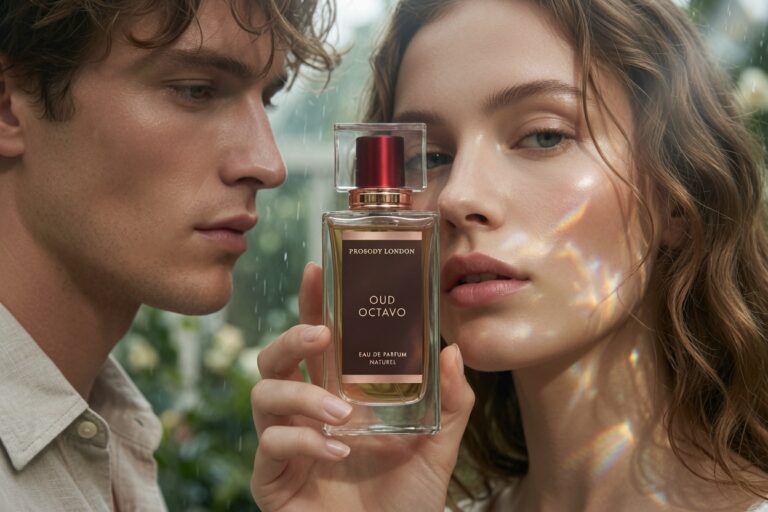
Prosody London's Oud Octavo 100% natural, long lasting perfume with amarylis and green flowers and roman bust

Oud Octavo → Deep Memory Anchoring

Frankincense runs through the base of Oud Octavo — and as the research above shows, incensole acetate from Boswellia resin has documented effects on TRPV3 channels in the brain, producing heightened emotional awareness and the altered cognitive state that has made frankincense central to contemplative and ritual practice across civilisations for thousands of years. Combined with oud’s profound tenacity, Oud Octavo stays present for a full day — providing consistent botanical input across hours rather than a brief top-note flash.

Lissom Linden perfumes men love on women in edwardian setting withn orange

Lissom Linden → Bright Memory and Active Recall

Not all memory work happens during consolidation and rest. Active recall — the ability to retrieve memories quickly and clearly during waking hours — depends on a different neurological state: alert, focused and cortisol-low. Bergamot opens Lissom Linden with documented cortisol-lowering and dopamine-activating properties — creating precisely the bright, calm alertness under which working memory and active recall perform best. Lissom Linden is the perfume for memory worn during the day when you need to be sharp, present and retrieving clearly rather than encoding and consolidating.


The Prosody London Memory Protocol — Seven Formulas, Seven Days and Seven Nights

The most striking detail of the UC Irvine study is not the result. It is the method. The researchers did not use a single fragrance continuously. They used seven different natural oils, rotating one per night across the week. The variety was deliberate — the brain responds to novelty, habituates to repetition, and requires different olfactory stimuli to keep the memory circuits actively engaged rather than filtering the scent out as background noise.

You can apply this protocol directly using Prosody London formulas — seven botanically distinct fragrances, each addressing a different mechanism of memory, worn throughout the full day and into the night.

The logic is straightforward. During waking hours, wearing botanical fragrance on pulse points provides continuous olfactory stimulation to the memory circuits while encoding is actively happening — every conversation, experience and moment of focus is being laid down as memory while the botanical compounds are present. Then as you sleep, the scent still on skin moves into the consolidation phase — the same period the UC Irvine researchers targeted with their diffuser protocol. One fragrance, worn fully across a complete day and night, then rotated the following day.

DayFormulaMemory mechanism
MondayNeroli Nuance →Linalool — hippocampal neurogenesis and circuit integrity
TuesdayRose Rondeaux →Rose oxide — emotional memory encoding
WednesdayMocha Muscari →Lavender / linalyl acetate — GABA and memory consolidation
ThursdayOud Octavo →Frankincense / incensole acetate — TRPV3 and neuroprotection
FridaySantal Foy →Sandalwood — parasympathetic activation and cognitive clarity
SaturdayCarissis →Lavender / carissa — intimate memory anchoring
SundayLissom Linden →Bergamot / linalool — active recall, bright and alert

Each formula targets a different compound and a different aspect of memory function. Together across seven days they cover the full spectrum of what peer-reviewed research identifies as the botanical mechanisms most relevant to memory — from hippocampal neurogenesis to emotional encoding to neuroprotection to cognitive clarity. Every day of the week a different mechanism. Every night the same formula consolidating what the day encoded.

Consistency across weeks and months matters more than intensity on any single day. The structural brain changes the UC Irvine team observed on fMRI built over six months of regular practice — not overnight. Start with the sample set, find the formulas that resonate most personally, then build the rotation around them.

This is not aromatherapy. It is a practical application of peer-reviewed neuroscience, using 100% botanical formulas that contain the actual compounds the research identifies — not synthetic approximations of their smell.

Our natural perfume collection contains all seven formulas. Our natural perfume sample set allows you to try each one before committing — which is the right approach when building a protocol you intend to follow for months rather than days.

For a dedicated guide to using room fragrance and diffusion for memory — including the full UC Irvine overnight protocol applied at home — read our article on room fragrance for memory.

For further reading on how botanical fragrance affects mood and emotional states, read our articles on perfume for anxiety and perfume that attracts happiness.

prosody london sample sets natural perfume on green chair with florals

Kershen Teo is the founder and perfumer of Prosody London, a 100% botanical fragrance house based in London. All Prosody London fragrances are formulated from natural and organic-compatible ingredients, with no synthetics at any stage of production.

Similar Posts