

There is a street in Valencia lined with bitter orange trees. I cycled down it in spring, when the blossoms were in full flower, and the experience stopped me entirely. The air was thick, sweet, slightly green, impossibly clean — the kind of scent that doesn’t announce itself so much as arrive all at once and stay. I have worked with neroli oil as a perfumer for years, but smelling it in the open air, on the tree, at the moment of bloom, is something entirely different. It is one of the most unforgettable olfactory experiences of my life.
That memory is not incidental to this article. The limbic inputs of the olfactory bulb in the amygdala and hippocampus are directly related to emotion and memory — which is why scent triggers emotional responses with an immediacy and persistence that no other sense can match. ScienceDirect Few ingredients demonstrate this more clearly than the oil distilled from those blossoms. It is simultaneously a perfumery staple, a clinically studied therapeutic agent, and — for anyone who has encountered it in nature — something that lodges permanently in memory.
I’m Kershen Teo, founder and perfumer of Prosody London. Here is what I know about neroli oil from both the laboratory and the tree.

What Is Neroli Oil?
Neroli oil is steam-distilled from the freshly picked blossoms of Citrus aurantium — the bitter orange tree. It is distinct from two related materials that come from the same plant: orange blossom absolute, which is solvent-extracted and carries a heavier, more honeyed character, and petitgrain, which is distilled from the leaves and twigs and has a greener, woodier profile. The oil specifically comes from the flower, captured at the moment of bloom through steam distillation — a process that preserves its volatile freshness in a way that solvent extraction cannot.
The yield is extraordinarily low. It takes approximately 1,000 kg of hand-picked blossoms to produce 1 kg of the oil — which is why it sits among the more expensive naturals in fine perfumery, and why it is rarely used at volume in synthetic fragrance formulas where cost-efficiency drives formulation decisions.
The primary producing regions are Tunisia, Morocco, Egypt, Italy and France. Valencia, where bitter orange trees line the streets and public squares, is not a major commercial producer — the trees there are ornamental — but they represent one of the most concentrated natural sources of the scent in the open air that you will ever encounter. Tunisian production tends toward greater freshness and citrus clarity; Egyptian material carries more depth and honeyed weight.
The name derives from Anna Maria de la Tremoille, Princess of Nerola, who in the 17th century popularised bitter orange blossom as a personal scent — applying it to her gloves, bathwater and linens. The ingredient had been used in perfumery and medicine across the Arab world and Mediterranean long before this — the word itself may derive from the Arabic naranj or the Sanskrit nagaran — but the Princess of Nerola gave it the European name that endured.
The Scent Profile
The aromatic character of neroli oil operates simultaneously on several registers, which is what makes it so difficult to reduce to a single descriptor — and so versatile in a perfumer’s hands.
At its freshest, immediately after distillation or application, it is bright, citrusy and slightly green — clean without being sharp, citrus without being sweet. As it develops, a soft floral warmth emerges: honeyed, slightly powdery, with an undertone that reads as intimate and skin-close rather than perfumed in the conventional sense. The bitter orange’s characteristic sharpness — that quality you encounter walking under the trees in Valencia, where the blossoms have an almost medicinal edge alongside their sweetness — softens progressively as the oil warms on skin.
What makes this ingredient remarkable as a perfumery material is its arc. Most ingredients perform their role and then fade. This oil moves — from fresh to floral to warm to intimate — in a way that mirrors how a well-composed fragrance should behave across hours of wear.
The Key Molecules and What They Do
The therapeutic and olfactory properties of neroli oil are attributable to a specific set of molecular constituents. Understanding them explains both why it smells the way it does and why the science on its therapeutic effects is credible rather than speculative.
Linalool is the most abundant compound, typically present at 10–54% depending on origin and harvest. A monoterpene alcohol known for its analgesic, anti-inflammatory and sedative properties, linalool has been shown in numerous studies to exert anxiolytic effects, support cognitive and emotional balance, and offer antimicrobial and antioxidant activity. Its actions on the central nervous system include antagonising glutamatergic receptors, inhibiting noradrenaline and serotonin receptors, and activating GABA receptors — mechanisms associated with anxiolytic and sedative outcomes. Essenceofthyme It is also the molecule primarily responsible for the oil’s soft floral warmth — the same compound that gives lavender its calming signature appears here in a fruitier, more citrus-inflected register.
Limonene contributes the bright citrusy top-note quality. It adds an uplifting effervescence that prevents the floral warmth from becoming heavy, and is one of the reasons the oil works so well as an opening note in complex compositions.
Nerolidol — present at around 5–9% — is a sesquiterpene alcohol that contributes soft, woody, slightly floral depth. It bridges top-note freshness with a lasting warmth that holds close to skin, which is why neroli oil anchors well in base-oriented compositions.
Linalyl acetate softens and smooths the overall profile, contributing the slightly powdery, intimate quality that makes the oil feel personal rather than perfumed. It works in concert with linalool to produce the oil’s signature skin-close character.
Research has confirmed that neroli oil, alongside bergamot, ylang ylang, geranium and rose essential oils, can affect the hypothalamic-pituitary-adrenal axis by decreasing glucocorticoid levels — producing a calming effect and measurable decreases in blood pressure and heart rate. Satcc These are not peripheral effects. They reflect the oil’s specific molecular composition interacting with neurological systems in ways that synthetic aroma molecules, designed for olfactory stability rather than biological activity, cannot replicate.
The Therapeutic Evidence
The therapeutic case for neroli oil is among the better-evidenced in commonly used perfumery botanicals, supported by peer-reviewed clinical trials rather than traditional use claims alone.
A 2022 randomised controlled trial published in Healthcare examined the effect of aromatherapy on anxiety and perceived pain in 88 women during labour. Perceived pain and anxiety in the neroli oil group were significantly lower than in the control group at all stages of labour (p < 0.05). As labour progressed, pain and anxiety increased in all participants, but the increase was measurably milder in the intervention group throughout. PubMed Central
Research has further highlighted its role in menopausal care, where inhalation was found to alleviate psychological distress, reduce perceived stress, and potentially influence oestrogen levels in postmenopausal women — supporting its use in addressing hormonal imbalances and mood disturbances during midlife transitions. Essenceofthyme
A 2023 scoping review of ten years of research into essential oils and the nervous system confirmed that citrus-derived oils including neroli oil consistently reduced stress and negative emotions alongside measurable reductions in stress hormones, with parasympathetic stimulation documented across multiple populations. MDPI
What is scientifically significant is the specificity of the mechanism. The linalool and limonene molecules interact with CNS receptor systems in ways that produce measurable physiological responses, independently of subjective scent preference. This is why the oil has been studied in clinical settings rather than only in aromatherapy contexts, and why its therapeutic profile is taken seriously in integrative medicine literature.
Why Perfumers Have Prized It for Three Centuries
The oil has been a staple of fine perfumery since the early 18th century, appearing in the original Eau de Cologne formulas and remaining present in fragrance composition to this day. Its endurance reflects genuine structural versatility that synthetic substitutes have never fully replicated.
Most ingredients occupy a clear position in the fragrance pyramid and behave predictably within it. Neroli oil does not. Depending on how it is used, it can function across all three registers. As a top note, its citrus-floral brightness provides an opening that is fresher than straight citrus but warmer than a green note. As a heart note, its floral warmth bridges citrus openings to deeper bases without the heaviness of rose or jasmine. In base-oriented compositions, nerolidol-rich fractions provide a lasting softness that holds a fragrance intimately close to skin.
This structural flexibility — combined with documented biological activity — is rare. It explains why the ingredient continues to be prized by perfumers working across every level of the industry, from heritage houses to contemporary naturals.

Neroli Oil in Prosody London Fragrances
The oil appears in three Prosody London formulas, and its role is different in each — which illustrates precisely the range that makes it such a valued natural ingredient.
In Neroli Nuance, it is the undisputed lead. The entire composition is built around orange blossom and neroli oil, with every other ingredient — candlewood, benzoin, jasmine sambac — chosen to illuminate and extend the central theme rather than compete with it. Writing in the Daily Mail, beauty journalist Jo Fairley described it as a super-elegant, summery blend taking white floral notes of orange blossom — noting its connection to wedding tradition, from Queen Victoria’s orange blossom crown to the modern bridal fragrance wardrobe. CaFleureBon’s Karl Topham described the composition as one where the ingredient absorbs surrounding notes while keeping the main protagonist at the centre. Liz Earle has cited Neroli Nuance as her favourite fragrance.

In Bebop Allure, it plays an entirely different role — one voice in a floral bouquet rather than a soloist. Its brightness lifts and connects the other floral elements without dominating, demonstrating how the oil can contribute architecture to a composition rather than character.
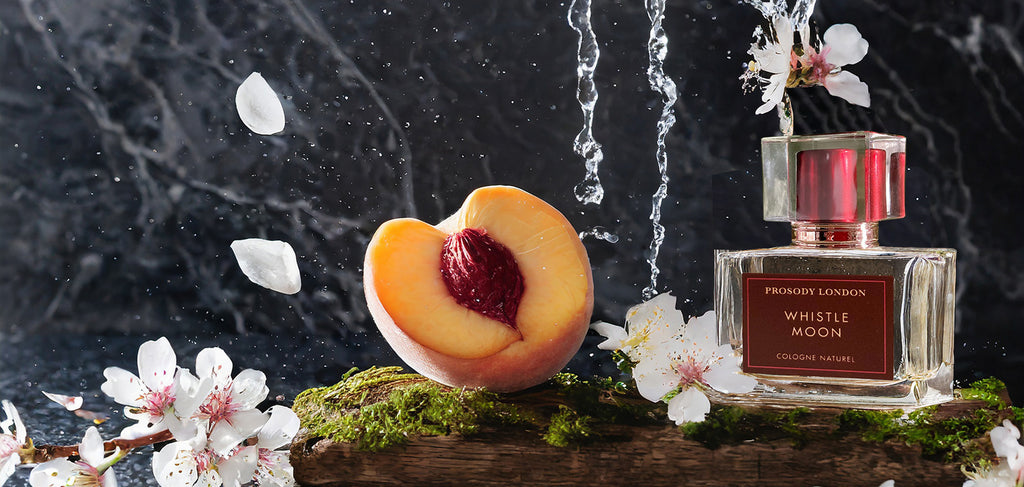
In Whistle Moon, it operates in a fruity aquatic context. Its citrus-floral lift provides the connecting thread between aquatic freshness and the warmer base elements — grounding what could easily become a dispersed formula and giving it coherence and skin-presence.
The same ingredient, three completely different expressive roles. This is what working exclusively with natural materials makes possible — and what synthetic substitutes, however technically proficient, cannot replicate in the same way.

Why Neroli Oil Matters Beyond Perfumery
There is something worth understanding about what you are smelling when you encounter neroli oil at its source. The aromatic compounds in the oil — linalool, limonene, nerolidol — are not incidental to the plant. They are secondary metabolites, produced in direct response to the environment the tree grows in. Increases in UV-B radiation from sunlight cause plants to produce more essential oils and phenolic compounds. Maxa Press Both UV and visible light act as important elicitors of terpenoid synthesis Frontiers — the molecular family to which linalool and limonene belong.
What this means, in practice, is that the Mediterranean sun is not backdrop to the scent of those Valencia trees. It is the reason for it. Every hour of light absorbed by the bitter orange blossom is converted, through the plant’s chemistry, into the volatile aromatic compounds that fill the air around it. When you walk under those trees in spring, you are smelling accumulated solar energy — months of Mediterranean light, distilled into something that stops you in your tracks. It is, in the most literal sense, the smell of abundance. We explore this connection further in our article on perfume ingredients and abundance.
The limbic inputs of the olfactory bulb in the amygdala and hippocampus are directly related to emotion and memory — and the impacts of aromatherapy are nearly immediate, working in part beyond conscious awareness. ScienceDirect Neroli oil, with its specific molecular composition, activates these systems in ways that are now well-characterised in clinical literature. The science explains the mechanism. But the mechanism only tells part of the story.
If you want to explore what it smells like across different compositional contexts, our natural perfume sample set includes Neroli Nuance alongside the wider Prosody London collection. For more on the science behind natural fragrance ingredients, read our article on natural perfume vs synthetic and our guide to hidden chemicals in perfume.
But if you ever have the chance to go to Valencia in spring — go. Walk or cycle through the old city when the bitter orange trees are in bloom. The streets fill with something that no bottle, however beautifully made, can fully contain. It is months of sunlight made scent, freely given. It is one of the most joyful, overwhelming, priceless sensory experiences available to a human being. You will not know what neroli oil truly is until you have stood inside it.
