10 Best Long Lasting Perfume 2026 — That Last 12+ Hours
By Kershen Teo | Founder & Perfumer, Prosody London
At a Glance — 10 Best Long Lasting Perfume 2026
This guide pairs 10 botanical alternatives — including Oud Octavo, Mocha Muscari, and Rose Rondeaux — against the mainstream longevity benchmarks they’re built to match: Baccarat Rouge 540, Black Opium, La Vie Est Belle, Flowerbomb, Portrait of a Lady, Le Labo Santal 33, Terre d’Hermès, Delina, and Molecule 01. For anyone searching specifically for a 24 hours long lasting perfume, we also cover the names that come up most — including Boadicea the Victorious and Roja. Full reviews and longevity science below.
| Best Long Lasting Perfume for Women | Best Long Lasting Perfume for Men | Best Long Lasting Unisex Perfume | Possible 24-Hour Longevity (Varies by Wearer) |
|---|---|---|---|
| Prosody London — Rose Rondeaux (9–11 hrs) | Hermès — Terre d’Hermès | Maison Francis Kurkdjian — Baccarat Rouge 540 (12+ hrs) | Boadicea the Victorious — Blue Sapphire Supercharged |
| Prosody London — Jacinth Jonquil | Prosody London — Oud Octavo (12+ hrs) | Prosody London — Santal Foy (6–8 hrs) | Roja — Oligarch |
| Viktor & Rolf — Flowerbomb | Prosody London — Mocha Muscari (8–10 hrs) | Le Labo — Santal 33 | Dior — Sauvage Elixir |
| Frédéric Malle — Portrait of a Lady | Tom Ford — Oud Wood | Escentric Molecules — Molecule 01 | Penhaligon’s — The Tragedy of Lord George |
| Parfums de Marly — Delina | Prosody London — Berry Blitz | ||
| Prosody London — Neroli Nuance | |||
| Prosody London — Whistle Moon |
I’m Kershen Teo, founder and perfumer of Prosody London. This guide covers the science of fragrance longevity, what to look for on an ingredient list, and which long lasting perfumes — tested and verified for 6-10+ hours of real-world wear — are worth your consideration.
Best Long Lasting Perfume for Women
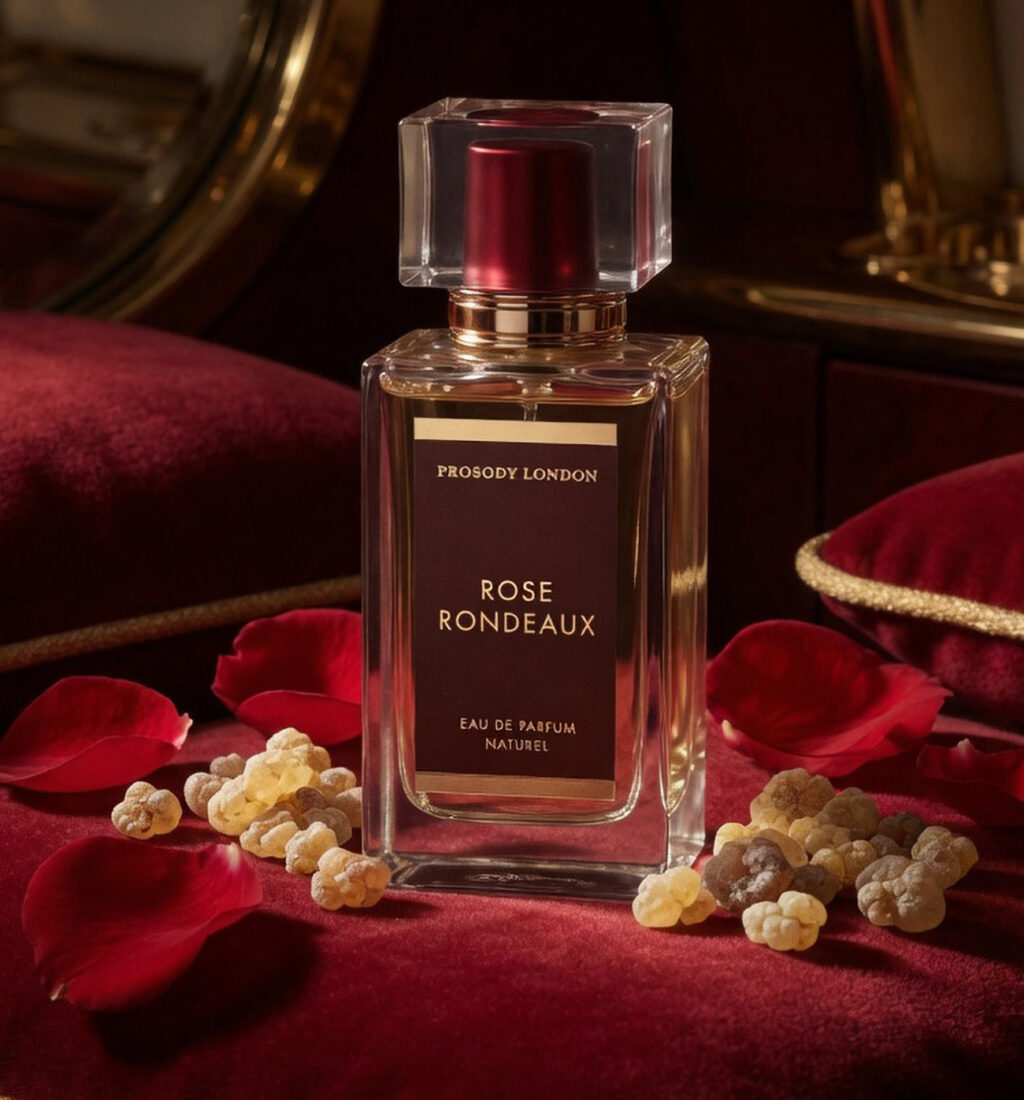
If you’re specifically searching for the best long lasting perfume for women, two botanical picks lead this list: Rose Rondeaux, our benchmark for long-wearing florals at 9–11 hours, built around rose oil, myrrh, sandalwood, and labdanum without a single synthetic fixative; and Jacinth Jonquil, a CO₂-extracted white floral that holds its honeyed brightness for much longer than the typical fleeting floral.
Both were formulated to address one of the biggest frustrations with women’s fragrances: florals can be among the quickest scents to disappear from skin. Mainstream benchmarks for long-lasting perfume for women — including Flowerbomb, Portrait of a Lady, and Delina — achieve exceptional persistence through modern fragrance technology and powerful synthetic materials. Rose Rondeaux and Jacinth Jonquil take a different approach: building longevity into the fragrance through the architecture of the natural materials themselves, using rich woods, resins, roots, and botanical extracts to anchor the floral heart.
The result isn’t necessarily the same kind of explosive projection associated with some modern designer fragrances. Instead, the aim is depth, persistence, and a scent that remains recognisably present on the skin as it develops, rather than simply disappearing when the opening notes evaporate.
24 Hours Long Lasting Perfume: Possible, But It Varies by Wearer
True 24-hour longevity perfume on skin is rare, but a handful of fragrances are repeatedly mentioned across Fragrantica, Basenotes and Reddit fragrance communities for exceptional staying power. Four names stand out in particular: Boadicea the Victorious, notably with Blue Sapphire Supercharged; Roja, with Oligarch; Penhaligon’s, with The Tragedy of Lord George; and, from the designer world, Dior, with Sauvage Elixir.
That doesn’t mean all four will reliably last 24 hours on every wearer. Skin chemistry, application, temperature, humidity and even the amount applied can make a substantial difference. Community reports range from long-lasting skin scents to fragrances that remain detectable on clothing well into the following day. That’s why, when discussing a “24-hour long lasting perfume”, it’s more accurate to talk about 24-hour potential than a guaranteed 24 hours of performance.
I’ll say this plainly, as a personal opinion rather than a criticism of any of these fragrances: extreme, near-24-hour longevity generally isn’t what I formulate for, and it isn’t really to my own taste. Fragrances engineered for that level of endurance often project more aggressively too — the same characteristics that keep a scent detectable late into the next day can make it fill a room during the first few hours.
None of that makes them bad perfumes. It’s simply a different objective, and a perfectly legitimate one if that’s what you’re looking for.
My own preference — and what I build toward with Oud Octavo and the rest of this collection — sits closer to 10–12 hours of intimate, skin-close wear, with longevity coming from the depth and persistence of botanical materials rather than from the heavily engineered synthetic structures often associated with the loudest, longest-lasting modern fragrances.
What Actually Makes a Long Lasting Perfume in 2026?
A perfume’s staying power is determined by the volatility of its ingredients — not its concentration label. Every fragrance is built in layers called notes, and each note evaporates at a different rate.
Top Notes: The Opening, Not the Lasting Impression
Top notes are the first thing you smell and the first to disappear, usually within 5–30 minutes. Citrus oils, aromatic herbs and light fruits live here. They create impact on first spray but contribute little to all-day wear.
Heart Notes: The Character of the Fragrance
Heart notes emerge after the top notes fade and last a few hours. Florals — rose, jasmine, ylang-ylang — and spices — cinnamon, cardamom — define the personality of the scent but need a strong base to anchor them.
Base Notes: The Real Key to Long Lasting Perfume
Natural base notes with exceptional longevity include agarwood (oud), sandalwood, vetiver, myrrh and frankincense, and labdanum — one of the finest natural fixatives available.
Ingredients longevity science
A 2025 study in the International Journal of Cosmetic Science modeled exactly this mechanism: fragrance molecules with higher molecular weight and lower vapor pressure evaporate significantly slower than lighter, more volatile ones — the physical basis for why more volatile materials tend to disappear earlier, while less volatile materials can remain detectable for much longer. It’s the same principle underlying the base notes recommended throughout this guide.
Hadjiefstathiou et al. (2025). “Exploring the impact of fragrance molecular and skin properties on the evaporation profile of fragrances.” International Journal of Cosmetic Science. Read the study
How to Identify a Truly Long Lasting Perfume
Ignore the EDP vs EDT Label. The concentration label is an unreliable guide to longevity. A well-formulated Eau de Toilette built on heavy base notes will outlast a poorly constructed Parfum. I have tested this repeatedly in our own lab. Here is what to look for instead.
Read the Ingredient List
Look for base-note ingredients that signal lasting power: oud, sandalwood, labdanum, vetiver, cedarwood, oakmoss, myrrh, patchouli and natural resins. These form the foundation of any fragrance that genuinely lasts all day.
Choose the Right Fragrance Family
Woody fragrances — sandalwood, cedar, vetiver — offer excellent longevity. Amber and resinous profiles — labdanum, myrrh, frankincense — are outstanding. Oriental and gourmand families — spices, vanilla, tonka — are consistently long-wearing.
Fresh, citrus and aquatic families are typically shorter-lived without strong fixatives — which is why most mainstream citrus fragrances rely heavily on synthetic extenders.
Wait for the Dry-Down
The true test of any long lasting perfume is the dry-down — 30 to 60 minutes after application. The scent that remains at that point is what you will wear for the rest of the day. Always test on skin, never on a strip. Body chemistry is part of the formula.
The Hidden Cost of Synthetic Fixatives in Long Lasting Perfume
Most mainstream long-lasting perfumes achieve their staying power through synthetic fixative molecules — principally polycyclic musks such as galaxolide (HHCB) and tonalide (AHTN), alongside compounds like Ambroxan and Iso E Super. These materials are effective, but a growing body of peer-reviewed research and regulatory action has raised questions about the environmental persistence, bioaccumulation and potential long-term effects of some synthetic fragrance ingredients.
Discovery of the first synthetic musk
Musk ketone and musk xylene weren’t developed as fragrance ingredients at all — they were discovered by accident in 1888 by German chemist Albert Baur, who was attempting to synthesize a more powerful version of TNT. The by-product wasn’t explosive, but it smelled strongly of musk, and he patented it for perfumery instead. Structurally, these “nitro musks” remain close chemical relatives of TNT — which is part of why later research into their photostability and toxicology raised concerns serious enough to phase most of them out of use by the 1980s.
Sources: ACS Molecule of the Week, University of Bristol
The Regulatory Picture — What Changed in 2025
The most significant development is not a research paper but a formal regulatory proposal. In January 2025, ANSES — the French Agency for Food, Environmental and Occupational Health and Safety submitted a proposal to the European Chemicals Agency (ECHA) to classify galaxolide as a Category 1B reproductive toxicant under the EU’s CLP Regulation — meaning it is regarded as presumed to cause damage to human fertility or development. Public consultation on the proposal closed in March 2025, with industry submitting comments opposing the classification. The dossier now awaits a formal opinion from ECHA’s Risk Assessment Committee, the next required step before any EU-wide classification can take effect — a process that, based on comparable cases, can take a year or more to reach a decision.
Galaxolide is one of the most widely used synthetic musks in fragrance globally, present in many mainstream perfumes and personal care products. A Category 1B reproductive toxicant classification, if confirmed, would represent a fundamental regulatory shift for the fragrance industry — and formulators have already been shifting toward more biodegradable macrocyclic musk alternatives in recent years, ahead of any final ruling.
Environmental Persistence
Galaxolide and tonalide are polycyclic musks whose intensive use in personal care products has resulted in widespread direct human exposure via absorption, inhalation and oral ingestion. Both compounds have been detected across river water, lake water, seawater, sediments and atmospheric particulate matter worldwide, and persist through conventional wastewater treatment processes.
Both compounds have been detected across river water, lake water, seawater, sediments and atmospheric particulate matter worldwide, and persist through conventional wastewater treatment processes.
Source: “Assessing Contributions of Synthetic Musk Compounds from Wastewater Treatment Plants to Atmospheric and Aquatic Environments.” Environmental Science & Technology (2024). Read the study
Human Tissue Accumulation
Both synthetic musks are lipid-soluble with very low molecular weights — the same chemical profile associated with compounds capable of crossing the blood-brain barrier. Polycyclic musks are absorbed through the skin and pass into circulation, reaching tissues throughout the body. A peer-reviewed study published in Neurotoxicology found that prolonged sub-lethal exposure to galaxolide and tonalide promotes the metastatic potential of glioblastoma tumour cells — with the authors noting that long-term, low-dose exposure to these chemicals can induce unpredictable harmful effects in living systems.
Doganlar, O., Doganlar, Z.B., Chasan, T., & Kurtdere, A.K. (2021). “Prolonged Sub-Lethal Exposure to Galaxolide (HHCB) and Tonalide (AHTN) Promotes the Metastatic Potential of Glioblastoma Tumor Spheroids.” Neurotoxicology, 87, 219–230. Read the study
What This Means for You
The authors of these studies are careful to note that toxic doses in laboratory conditions generally exceed typical real-world exposure levels — and that more research into long-term cumulative exposure is needed. This is not a reason for alarm. It is a reason to choose carefully, particularly given that perfume is applied daily, directly to skin, over years.
If longevity is your priority and you are willing to accept synthetic fixatives, many mainstream fragrances will deliver. But if you want a long lasting perfume that performs without these trade-offs — for you, your skin and the environment — high-quality natural perfumery is now a genuine alternative. For a fuller breakdown of the chemicals found in synthetic fragrance, read our guide to hidden chemicals in perfume.
Why This Matters Right Now: The Industry Is Already Responding
The regulatory picture isn’t happening in a vacuum. Fragrance manufacturers have been developing alternative musk materials that can deliver the softness, diffusion and tenacity of traditional synthetic musks while offering different environmental profiles. Among the most established examples are Habanolide, Romandolide and Helvetolide, all commercial fragrance materials from DSM-Firmenich.
Habanolide is a macrocyclic musk that DSM-Firmenich describes as readily biodegradable, while Romandolide belongs to the alicyclic musk family and is specifically described as resembling the typical character of some polycyclic musks without belonging to that chemical family. DSM-Firmenich also describes Helvetolide as a musk with a different volatility profile and a partially biodegradable environmental profile. These materials demonstrate that the industry now has commercially established alternatives to some of the older, more persistent musk chemistries.
The contrast is particularly clear with Galaxolide (HHCB) itself. IFF lists Galaxolide as a highly persistent musk with substantivity of more than 48 hours and classifies it as non-biodegradable. This doesn’t mean that every modern perfume has eliminated Galaxolide, nor that every reformulation is driven by environmental considerations. But it does show that perfumers have access to newer musk technologies that can provide substantial performance while addressing biodegradability concerns.
This may also help explain a question that comes up repeatedly in fragrance communities: why do some older perfumes seem to last longer than their modern versions? Reformulation is a complex process, and changes can result from many factors — including ingredient availability, regulation, cost, IFRA restrictions, olfactory direction and sustainability objectives. It would therefore be too simplistic to attribute every reduction in longevity to the replacement of one particular synthetic musk.
What can be said with greater confidence is that fragrance chemistry has changed significantly over time, and the industry has developed new generations of musk materials with different persistence and environmental characteristics. For a deeper look at the broader question of why some modern perfumes can seem less powerful or long-lasting than their predecessors, see our article on why perfumes nowadays don’t last as long.
Natural Perfumery’s Answer to All-Day Longevity
A persistent myth holds that natural perfumes do not last. This is simply not true of high-quality botanical formulations. At Prosody London, we use rare CO2 extracts, high-index botanical resins and upcycled vetiver to achieve 8–12 hours of real-world wear — without a single synthetic fixative.
Fragrance critic Luca Turin, who has reviewed thousands of perfumes across his career, described Prosody London’s work as: “Organic perfumes are very hard to make — these guys are very good at it.”
The Best Long Lasting Natural Perfumes from Prosody London
Each of the following has been formulated specifically for all-day wear using botanical base notes. Wear times are based on real-world skin testing across different skin types and conditions.

Oud Octavo — Best for Depth and Maximum Longevity
Tom Ford Oud Wood is the benchmark mainstream oud — built on synthetic oud accords and cedarwood rather than genuine agarwood, which is prohibitively expensive at commercial volume. It emphasises a smooth, modern woody accord, beautiful and successful in its own right, though not the intensely animalic, resinous profile associated with natural agarwood.
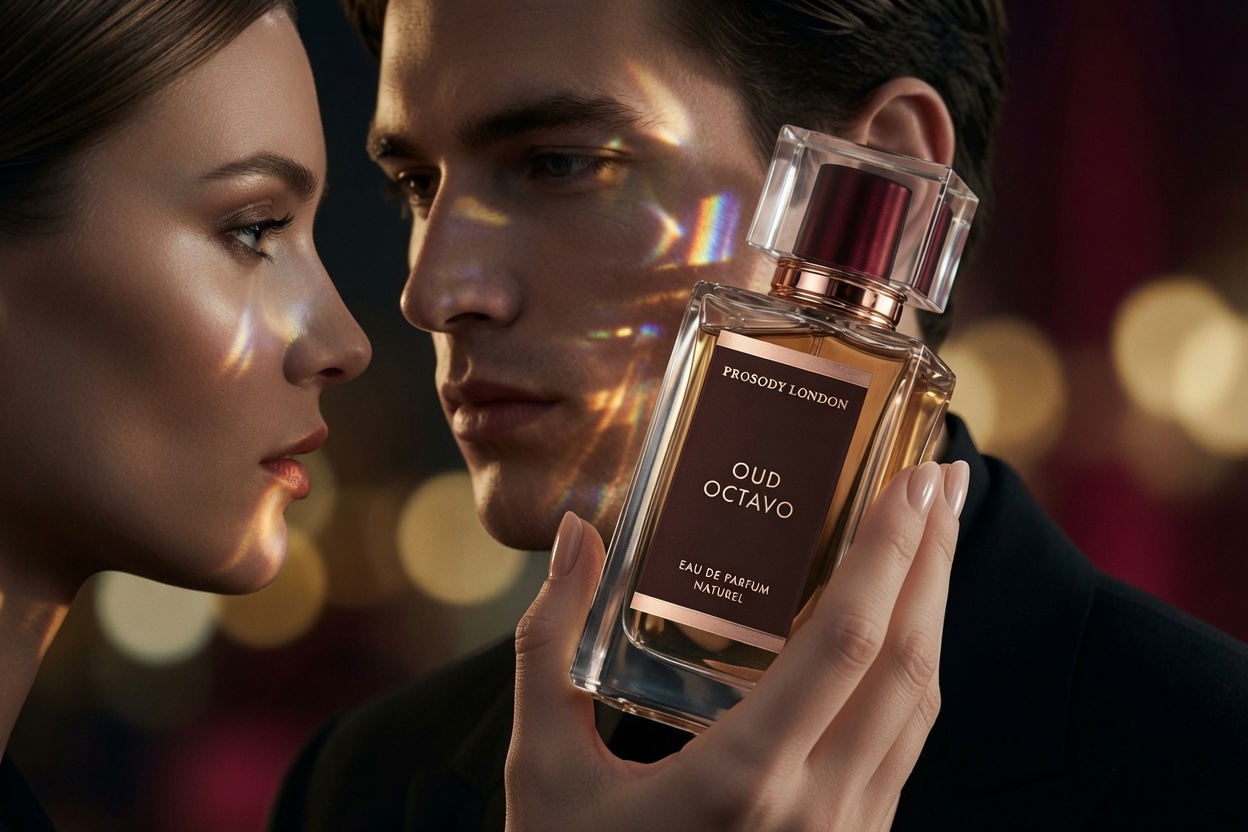
Built around profound oud and labdanum resin, Oud Octavo consistently delivers 12+ hours of full-day wear. The oud base is one of the most tenacious materials in natural perfumery — and labdanum, a warm amber-like resin from the Mediterranean cistus shrub, acts as a natural fixative that holds everything above it in place. This is our benchmark for natural longevity.

Rose Rondeaux — Best Long Lasting Floral
Frédéric Malle Portrait of a Lady sets the ingredient-quality benchmark for rose, but even at this price point, its exceptional longevity comes partly from synthetic musks in the base.
Rose, myrrh, sandalwood and labdanum combine to prove that delicate florals can have genuine staying power. The resinous base anchors the rose heart for 9–11 hours on most skin types. Myrrh is particularly effective here — its high molecular weight means it evaporates very slowly, creating a lasting warmth beneath the floral.

Berry Blitz — Best Long Lasting Fruity
Parfums de Marly Delina uses a rhubarb-rose-vanilla accord that reads as youthful and fresh — but like most fruity-florals, its staying power leans on synthetic fixatives to keep the fruit from fading within an hour.
Juicy berry top notes are anchored by oakmoss and an earthy-woody base, creating a fragrance that stays vibrant for hours. One of our most impressive demonstrations that fruit-led scents can achieve genuine all-day wear through base note architecture rather than synthetic fixatives.

Jacinth Jonquil — Best Long Lasting White Floral
Viktor & Rolf Flowerbomb is explosive and long-lasting by design — a genuinely successful piece of construction, reinforcing its patchouli-vanilla base with synthetic amplifiers to achieve maximum projection and staying power. It’s a different kind of achievement to a botanical white floral: bold and immediate rather than something that unfolds slowly on skin.
Jonquil in full bloom, with honeyed facets and a softly luminous base. Built using CO2 extracts that preserve delicate top molecules often lost in conventional distillation — the result is a fresh, elegant white floral that does not sacrifice longevity.

Santal Foy — Best Long Lasting Woody
Le Labo Santal 33 became cultural shorthand for skin-close woody perfume — but its structural base is Iso E Super (OTNE), a synthetic woody molecule, not genuine sandalwood.
Sandalwood-led and deeply grounded, Santal Foy is our benchmark for masculine longevity. Sandalwood’s large sesquiterpene molecules are among the slowest-evaporating in natural perfumery — this fragrance is present from morning to evening without needing to reapply.
Shop Santal Foy →

Neroli Nuance — Best Long Lasting Citrus-Floral
Tom Ford Neroli Portofino is the modern reference for neroli done at luxury level — a genuinely accomplished composition, bergamot, lemon, and mandarin amplifying the citrus brightness of the neroli before it settles into a warm, slightly woody base, engineered specifically to hold that Mediterranean brightness on skin far longer than neroli alone naturally would. It’s a different kind of longevity to a botanical citrus-floral: precise and consistent by design, built to smell identical from first spray to final hour.
Neroli and blood orange open Neroli Nuance bright and immediate, before orange blossom deepens the heart — warmer and more lingering than neroli alone. The labdanum base is what makes this more than a fresh citrus: a resin harvested from the cistus shrub in the Mediterranean, it brings ambery depth that gives this light fragrance genuine staying power, while oakmoss adds a cool, mossy grounding note. The result is a fragrance that reads as effortlessly bright on first application and holds that brightness far longer than the notes alone would suggest — an elegant embrace that evolves rather than repeats.
Longevity note: Labdanum resin contains complex diterpene alcohols that form a semi-permanent bond with skin proteins — the same fixation mechanism at work in Rose Rondeaux. Oakmoss is one of the oldest and most respected natural fixatives in perfumery, central to chypre construction for exactly this reason.

Mocha Muscari — Best Long Lasting Gourmand
Baccarat Rouge 540 and Black Opium both achieve their addictive, long-wearing warmth through synthetic ambers and vanillin — a genuine achievement in modern perfumery, these materials engineered specifically to hit that warm, ambery, faintly sweet register with remarkable precision and consistency. It’s a different kind of warmth to a botanical amber base: exact and repeatable by design, rather than the more variable, evolving warmth resins bring.
Rich, intoxicating and deeply tenacious. Mocha Muscari pairs the dark warmth of mocha with muscari’s exotic floral edge, anchored by a base that consistently delivers 8–10 hours on skin. The camphoraceous edge of the lavender bonds with labdanum to create a roasted coffee depth that is as persistent as it is unusual.
Shop Mocha Muscari →

Whistle Moon — Best Long Lasting Aquatic-Aromatic
Creed Aventus built its reputation partly on a cool, mossy-woody drydown — but the natural oakmoss note most people associate with that quality is now delivered by synthetic aroma chemicals, since IFRA restrictions limit how much real oakmoss can be used in leave-on products.
Whistle Moon opens with neroli, melon, and mandarin — fresh and slightly ozonic — before cinnamon and olibanum bring warmth into the heart. The base is where it becomes distinctive: peach, seaweed, and myrrh together create a resinous, marine-tinged depth. Myrrh’s high molecular weight is what gives this atmospheric, ozonic-opening fragrance real staying power in the base, lasting 6–8 hours.
[Explore our Discovery Sample Sets →]
How to Make Any Long Lasting Perfume Last Even Longer
These techniques are tested and recommended from our own formulation work:
Apply to pulse points. Wrists, neck, behind the ears and inner elbows are where blood flows close to the surface, generating warmth that activates and projects fragrance throughout the day.
Do not rub. Rubbing wrists together after spraying breaks fragrance molecules and accelerates evaporation. Spray and leave.
Moisturise first. Fragrance clings to moisture. Applying an unscented body lotion before your perfume creates a base that significantly extends wear — particularly effective for dry skin types, which tend to absorb fragrance faster.
Layer strategically. Botanical ingredients harmonise naturally when layered. Pairing a resinous base like Oud Octavo with a floral top like Jacinth Jonquil creates a complex, evolving sillage that lasts longer than either alone. See our natural perfume layering guide for specific combinations.
Store correctly. Natural ingredients are sensitive to light and heat. Store your perfume in a cool, dark place — not in the bathroom, where humidity and temperature fluctuation degrade the essential oils over time.
Try Before You Commit
Natural perfume must be experienced on skin to truly bloom. It interacts with your unique body chemistry in ways that a strip test cannot reveal — the same formula can smell quite different on different wearers. We strongly recommend our Discovery Sample Sets which allow you to wear each fragrance through its full 8–12 hour cycle before committing to a full bottle.

FAQ about long lasting perfume
Is a long lasting perfume the same as a “beast mode” fragrance?
No — longevity and projection are different things, often confused. “Beast mode” refers to a fragrance that projects aggressively, filling a room and announcing itself from a distance (usually achieved through heavy synthetic amplifiers like Ambroxan). A skin scent, by contrast, can last just as long — sometimes longer — while staying close to the body, discovered only at proximity. Several fragrances on this list, including Neroli Nuance and Whistle Moon, are built as skin scents: genuinely long-lasting, but designed to reward closeness rather than announce themselves across a room. Longevity is about how long a fragrance survives on skin; projection is about how far it travels. A fragrance can have one without the other.
What is the best long lasting perfume?
It depends on the character you want, but among 100% botanical perfumes, Oud Octavo (12+ hours, resinous oud) and Mocha Muscari (8–10 hours, gourmand) lead on raw staying power. Among mainstream fragrances, longevity typically comes from synthetic fixatives like galaxolide — effective, but currently under regulatory review in the EU for potential reproductive toxicity.
Does a higher perfume concentration (EDP vs EDT) always mean longer wear?
No. Concentration label is an unreliable guide to longevity. A well-formulated Eau de Toilette built on heavy base notes — oud, sandalwood, labdanum — will outlast a poorly constructed Parfum. What matters is the base note architecture, not the percentage on the label.
Why do synthetic musks last longer than natural ingredients?
They generally do, and it’s worth being honest about that rather than overselling the natural case. Synthetic musks like galaxolide and tonalide are engineered specifically for maximum skin-binding and minimal evaporation — that’s their entire purpose, and nothing in nature is built quite so single-mindedly for the job. Natural materials with high boiling points — genuine oud, Mysore-grade sandalwood, labdanum, vetiver — can achieve genuinely long wear, often 8–12 hours, through the same physical principle of slow evaporation. But matching a synthetic fixative engineered specifically to outlast everything else is a different bar than “lasts all day,” and the honest answer is that the best synthetic musks still have an edge at the extreme end. What natural materials offer instead is a fragrance that evolves rather than staying static, and none of the environmental persistence or regulatory questions currently attached to compounds like galaxolide.
Are the synthetic fixatives in long-lasting perfume safe?
Galaxolide, one of the most widely used synthetic musks, is currently under review by ECHA for potential classification as a reproductive toxicant, following a January 2025 proposal from France’s ANSES. Both galaxolide and tonalide have also been detected accumulating in human tissue and the wider environment. Researchers note that laboratory toxic doses generally exceed typical real-world exposure, so this isn’t a reason for alarm. It’s also worth knowing the industry has already developed biodegradable alternatives like Habanolide and Romandolide — some wearers choose fragrances built on these or on natural fixatives specifically because of the persistence and regulatory questions still attached to galaxolide and tonalide.
How can I make a long lasting perfume last even longer?
Apply to pulse points on moisturised skin, don’t rub your wrists together after spraying, and store the bottle away from heat and light. Layering a resinous base fragrance with a lighter top note — for example Oud Octavo under Jacinth Jonquil — also extends overall wear time.
Does 24 hour long lasting perfume still exists
Very few fragrances genuinely do, and claims of 24-hour wear are usually more marketing language than measured reality. If you’re looking for a 24 hours long lasting perfume, the names that come up most consistently in fragrance communities for approaching it are Boadicea the Victorious’ Blue Sapphire Supercharged, Roja’s Oligarch, Penhaligon’s Tragedy of Lord George, and Dior’s Sauvage Elixir — even these vary considerably by skin type and application, and no fragrance reliably delivers a true, measured 24 hours for everyone. Among 100% botanical perfumes, Oud Octavo is our own benchmark — genuinely 12+ hours through real agarwood and labdanum, honestly short of a full 24, but built without the synthetic fixatives that get closest to that extreme end.
Explore our full range of long lasting natural perfumes for women, natural perfumes for men, and unisex natural perfumes.